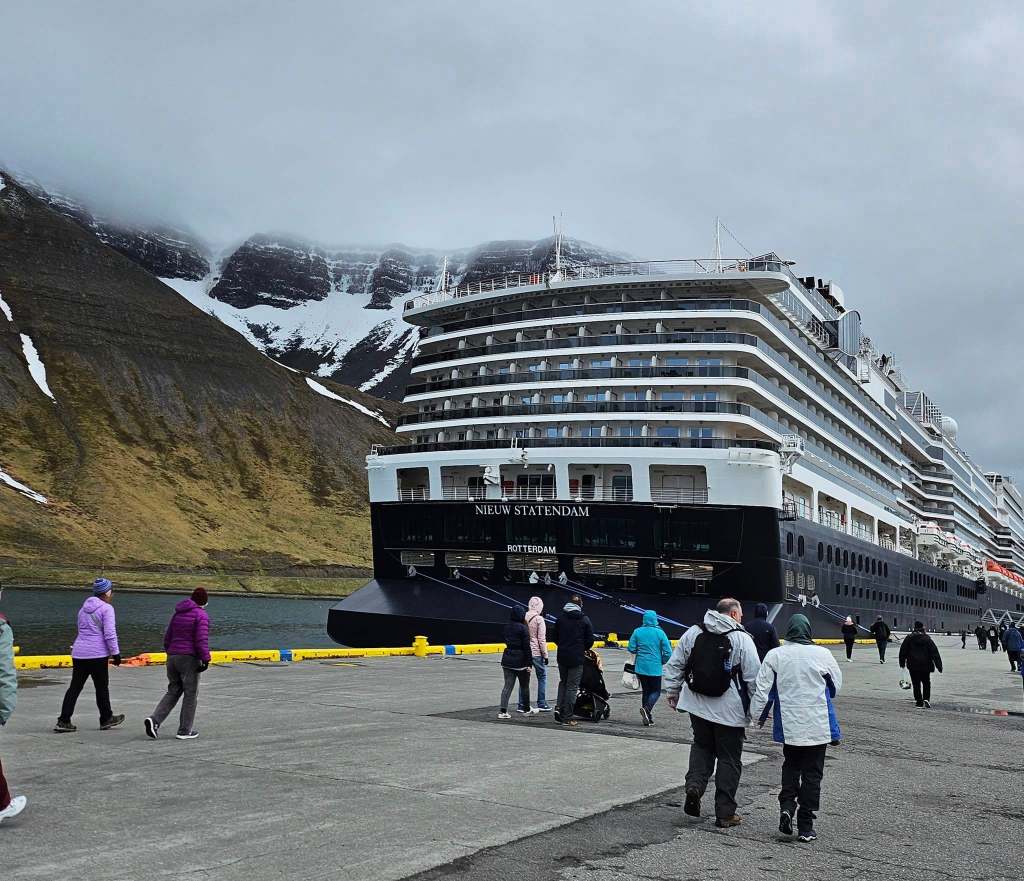
Holland America 22-day cruise from Copenhagen to Reykjavik
The Context
‘I’ve never been keen on cruises and I’m on this Nordic diet,’ I stutter when my friend tells me she’s going on a Holland America cruise. ‘There’d be lactose, yeast and eggs in everything.’ Noisy bands, gaudy atrium full of ageing drunks and spas full of shrieking gusset goblins… I add in my head.
She gives me her triumphant, gotcha-on-a-technicality tone of voice. ‘The one’s I’m looking at go to Nordic countries.’
My DNA’s almost half Norwegian and just a little bit less than a fifth Danish. I’m a smidgeon envious but in my whole life, no one who’s returned from a cruise has ever told me of it being a deep cultural experience. ‘Oh, have fun. I need to work and there won’t be Internet.’
She informs me wi-fi packages are available on cruises these days. Upselling of ‘extras’ by wage slaves who are forced to smile at you.
As a non-drinking, crowd-eschewing introvert, I peruse the brochure without intent. It promises that Holland America’s Nieuw Statendam hits a sweet spot which is ‘calm without being boring and is geared to adults without isolating families.’
Later I sneak more of a look online. Although the Holland America website’s hard to navigate, so many cruises are on offer! I’m dazzled. The itinerary of a twenty-two-day cruise from Copenhagen to Reykjavik is impressive in the number of ports visited and variety of shore experiences offered. And not one of the glossy photos features a galah with a glass in hand or STD (Sexually Transmitted Dependent).
Copenhagen
Having persuaded my German friend to come and share the cruise experience, I’ve flown into the Danish capital from Sydney via Bangkok on a t-shirt-friendly early morning in late May. I’ve eight hours to get a taste of Denmark before my co-explorer arrives. We’ll be staying at the conveniently located Absalon Hotel, only a block’s yomp over cobblestones from Central Station. The airport station’s thumping, but the train to the city is easy to negotiate with my debit card and I leave my luggage in a locker at the hotel.
Around the corner, ‘Tivoli Gardens’ is marked on the map. It might be nice to stroll around a garden, but I discover that it’s an amusement park, so keep walking through a spacious city that’s just coming to life. The buildings ooze a neat Nordic charm and there’s a happy, unhurried vibe. I pass a Lego Shop and cross the road to see a statue of Hans Christian Andersen. My aunt sent me a postcard with the Little Mermaid statue on it when I was six years old. With a complete lack of plans (so unlike me!) I decide to visit it. There’s a taxi rank in the large square behind the HCA statue and I ask a driver to take me there. His English is better than mine and he tells me that no-one tips or expects tips in Denmark, which is good to know.
A stream of commuting cyclists converges with the busloads of Instagrammers descending on The (underwhelmingly) LittleMermaid. There’s a scrupulously clean toilet block and a cluster of strategically placed coffee carts here. Tall, blond folk relax on benches around a fountain featuring one of the Norse god-pantheon— Geflion. She’s standing on a plough drawn by her cluster of wild-eyed oxen. I join the locals at her feet. We sip our coffees and contemplate the harbour view. Something I’ve immediately noticed about Danish coffee culture is that they don’t get coffees ‘to go’. They all ride bicycles and though very few wear helmets, they probably have a rule about sipping and wobbling.
Recaffeinated, I decide to walk back to my hotel slowly. The taxi-driver had pointed out the ‘must-see’ rococo Amalienborg Palace precinct. It’s home to King Frederik and ‘our’ Queen Mary. ‘We all love her,’ the driver told me. The precinct is practically deserted early in the day, except for a few royal horse guards clopping along its cobbled streets.
Crossing King Christian the somethingth Square with it’s impressive equine statue, my camera and I go, ahead of the lunchtime hordes, to Nyhavn—the chocolate-box harbourfront lined with stereotypical rainbow Scandic buildings. Raucous seabirds circle, scoping my backpack with gimlet eyes. Church bells ring out from several quarters and every yacht proudly flies the Danish flag at a jaunty angle from its stern.
The homely smell of baked goods, the clink of non-airline cutlery and the chatter of laidback diners in an outdoor square set my stomach rumbling. Remembering to ask for no eggs, I enjoy a flatbread smørrebrød featuring sild (pickled herring) and kale, before heading to the National Museum of Denmark.
The old building’s cool, dark and smells of wood and furniture polish—soothing for jetlag. It has an extensive permanent display about The Viking Age, (roughly three-hundred years from 800CE). Viking supremacy kicked off in Denmark, so it’s symbolic that my journey in the backwash of the Vikings should start here.
The First official Danish king was Harald Bluetooth. My fuggy brain attempts to generate a pun about ‘syncing’ and ‘sinking’. There’s an information panel about Cnut the Great, every sniggering fifth-grader’s favourite Viking name. Cnut was a Danish prince/king who invaded and ruled England in the early eleventh century and filled with his own importance, erroneously boasted that he’d will the tide not to come in and wet him.
The stand-out feature is entitled Viking-age Sorceresses. The written information is duplicated in English but the ‘guided audio tour’ is in Danish only. Sorceresses were more powerful than witches. They painted their faces white with lead-based paint and kept cats as familiars. It was only when Christianity came to the Viking world that suddenly women with a bit of spunk became evil ‘witches’.
Finally, I am able to check in and have a shower and several hours’ nap before my first friend —the one who showed me the cruise initially—arrives. There is no shortage of restaurants at which to eat dinner, but coming from Barraba, NSW, we’re attracted to one called Barabba, which turns out to be a vibrant Italian joint. Great IBS-friendly food and a selection of wines from a variety of terroirs should we want to drink.
The Cruise
A forest of slowly turning turbines in an offshore wind farm waves a laconic farewell from Copenhagen. My German friend had arrived late the night before by train from Munich. We soak up the golden evening sun at the kid-free pool as Nieuw Statendam slips smoothly up the Øresund Strait between Denmark and Sweden. We are conned into buying the eight-dollar-a-day soft drink package. Water is not included, so it proves to be not worth the expenditure; very expensive souvenir tumbler is included.
There are altogether, only five days ‘at sea’, and the usual cruise activities and facilities are available then and every day. Pickleball, impressionist painting and line-dancing appear especially popular and my gym-junky companion raves about the equipment choices at the gym. She enjoys riding the bikes which face the same view as from the bridge.
There are plenty of serene daytime spaces with tasteful decor where I can work in peace, but which come to life at night with a variety of highbrow music acts. The sun’s shining well beyond our bedtimes, so we’re glad of the block-out curtains in our stateroom, as we sail in and out of the Arctic Circle. We especially appreciate the room-tidying fairies who do their magic whenever we’re out of the cabin. It’s like staying at Mum’s place used to be. The best thing is that their tip is factored into the overall cost of the cruise.
Holland America, as promised, has first-rate nosh. Every possible taste, allergy and food fetish is catered for in the spotless dining room, Lido Market Buffet and five specialty restaurants. Room service is efficient, and you can slip on a warm jacket to dine on pizza, hot dogs or chips while taking in a poolside movie on a sunlit night. All classic cruise stuff.
Days Three-Eight: Norway, Part 1
Barmy sunny weather sees us walking the picturesque, art-nouveau town of Ålesund. As with everywhere in Norway, the prevailing breeze carries a fishy aroma and the cries of seagulls. It’s blowing from the direction of the island whence a notorious band of Viking raiders embarked, lured by the riches of France. The fearful West Francian king (incidentally, he was Charles III as well) struck a deal with their leader, Rollo, and gave them Normandy in return for a promise to leave the rest of his country alone.
Less than two centuries later the old plundering tradition came in strong for Rollo’s descendants. The Normans, as they were now known, headed across the Channel to invade England in 1066. Several of my ancestors were with William the Conqueror and I assume their ancestors were with (or even were) Rollo. It’s a fresh, sunny day and I squint across the water trying to make out the features of the forested ancestral island. Our guide, Lars, hands me some binoculars. I feel a deep contentment. The history of the town is nice, but it’s the connection which is important.
There’s ample time to explore Sunnmøre Open-Air Folk Museum nearby, where ‘construction’ has started on an enormous mid-summer bonfire, a tradition enjoyed since Viking times. Sunnmørefeatures historical marine craft and red-brown Viking buildings with space underneath to glide the longboat in. Most are those quirky sod-roofed houses which are ‘mowed’ by goats. There’s a windowless church, because the early Christian Vikings had never actually seen a church building to know to include windows. Back in Viking days, timber was preserved using cod-liver oil, which gave the buildings that mission-brown colour. It, however, fuelled the fire that burned most of Ålesund to the ground in the nineteenth century, and fire-resistant paint of the same colour is used these days.
Trondheim, formerly known as ‘Nidaros’ was the Norwegian Viking capital. Nieuw Statendam docks beside a statue of Leif Eriksson, who, I later learn in the Saga Museum in Reykjavik, colonised Iceland, taking women collected by force in Ireland because the Norwegian women refused to live in such a cold outpost.
Nidaros Cathedral began life in the 12th Century as a tomb for Saint Olav. He’s celebrated in the Viking sagas for bringing Catholicism to Norway; amid much head-lopping if the fifty or so sculpted figures adorning the facade of the church are anything to go by. The axes in the reliefs were the trademark weapon of choice of the Norwegian Vikings and are still widely used in the Scottish Hebrides, whence a stack of my other ancestors came.
From Honningsvag, Norway’s northernmost town, in an area not settled by the Vikings, the mind-blowing, and chilly North Cape Hall Excursion takes us through scenic tundra inhabited by the Sami people. Several herds of reindeer chew cud beside the road on the drive to Nordkap (North Cape) which is a monolith marking the end point of mainland Europe. It had been on my German friend’s bucket list, so I think provided the tipping point in persuading her to join me on the trip. Reindeer were perhaps the single most significant wild animal for the early Vikings. Every part of the animal was used and hunting them was a regular activity, as was raiding the Sami lands for other commodities.
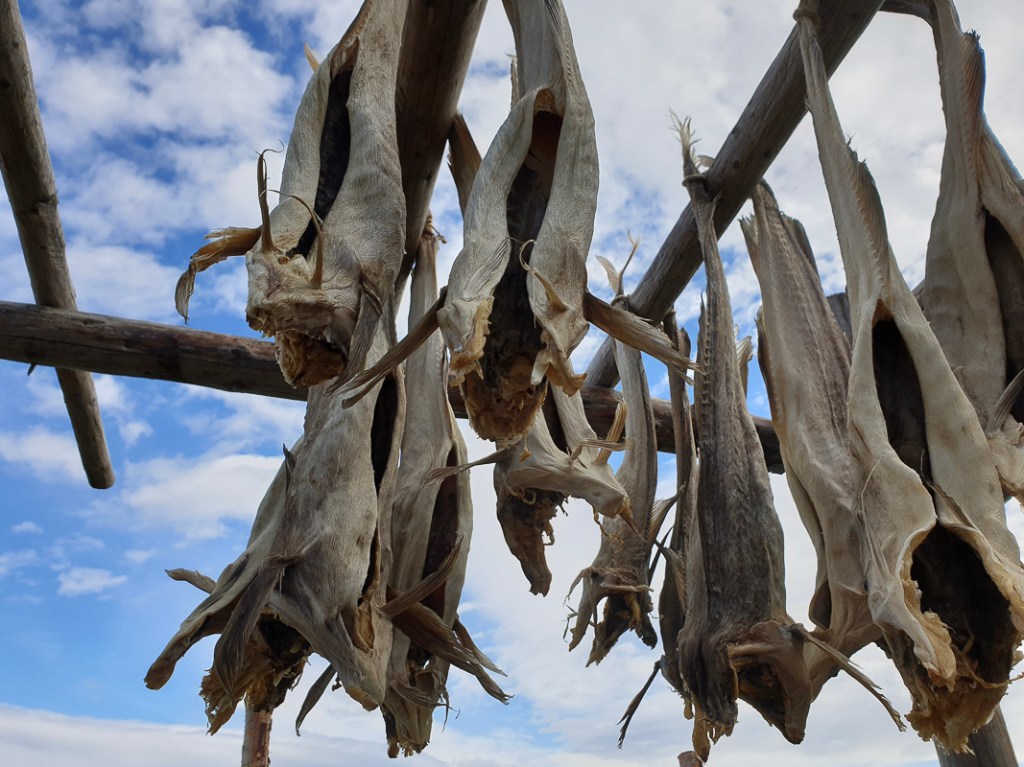
Tiny Harstad, still inside the Arctic Circle, tumbles down the side of Vågsfjord and features wool and craft shops, a hamburger joint advertising ‘Down Under Burgers’, and flowerbeds glorious with daffodils despite the patchy snow on the ground. There’s a walrus statue in the main street because, back in the day, the northern Vikings were dependent on a trade in walrus blubber. When Christianity was finally accepted, the main trade commodity of the area became dried stockfish, which can still be seen hanging on frames throughout Northern Norway and Iceland.
The clan system (from which the Scots’ system developed) and the Norse religion lasted longer in this northern part of Norway. We’re not booked on any excursions this time in Harstad, but on a previous polar-night trip to Norway, I’d visited the Trondenes Historical Centre and the most northerly surviving mediaeval stone structure in Europe—the whitewashed Trondenes Church.
Outside the centre, in summer, is a recreated medieval farm. Hens run wild, sheep graze and bees are working the flax and herb flowers. There’s a log fire on the hearth in the årestua (open-hearthed house) where we’d sampled some mead from Viking horns.
Vikings would often murder enemies or rivals by poisoning their drinks. To ascertain that their own drink wasn’t deadly, they’d smash their drinking vessels together to make sure they got their wine in the other cup. As they stared into each other’s eyes they’d look for a reaction to see if their own bevvie was safe or not. Then they’d say ‘Skål’ and down their drinks together.
Riding the Saltstraumen—the World’s strongest tidal current near Bødo (pronounced ‘Buddha’)— on an RIB (Rubber Inflatable Boat) is the wildest excursion of our cruise. We continue up the spectacular fjord after the adrenalin slows, passing a dig-site where a Viking village is being excavated. The boat drivers cut the engines so we can hear the silence. They toss fish to wild eagles. The birds circle overhead and dive in close. I feel the swoosh of their wings. The mingled scent of fish and pine forest is the same, our driver tells us, as it was when the Vikings lived in the village. By training solitary raptors to hunt for them, Vikings were able to access a greater variety of food.
Days Ten to Thirteen: The United Kingdom
King Christian I of Denmark and Norway sold The Shetlands to Scotland in 1468 to pay his daughter’s dowry. The imprint of the Norse can still be heard, in the names of places, geographical features, people and birds, and the lilt of the Shetland dialect. Some experts believe that the Vikings first brought otters to the Islands, which are well beyond swimming range of the mainland.
We wander the streets of the capital, Lerwick. It looks as it does in the Shetland TV series, even down to Detective Jimmy’s house. A visit to the Museum is a chance to see artifacts excavated from nearby Jarlshof, and imaginative pictorial recreations of the Viking longhouse found there. I buy my husband a Viking tee-shirt at the hardware store. He’s a larger size than those usually sold in souvenir caves.
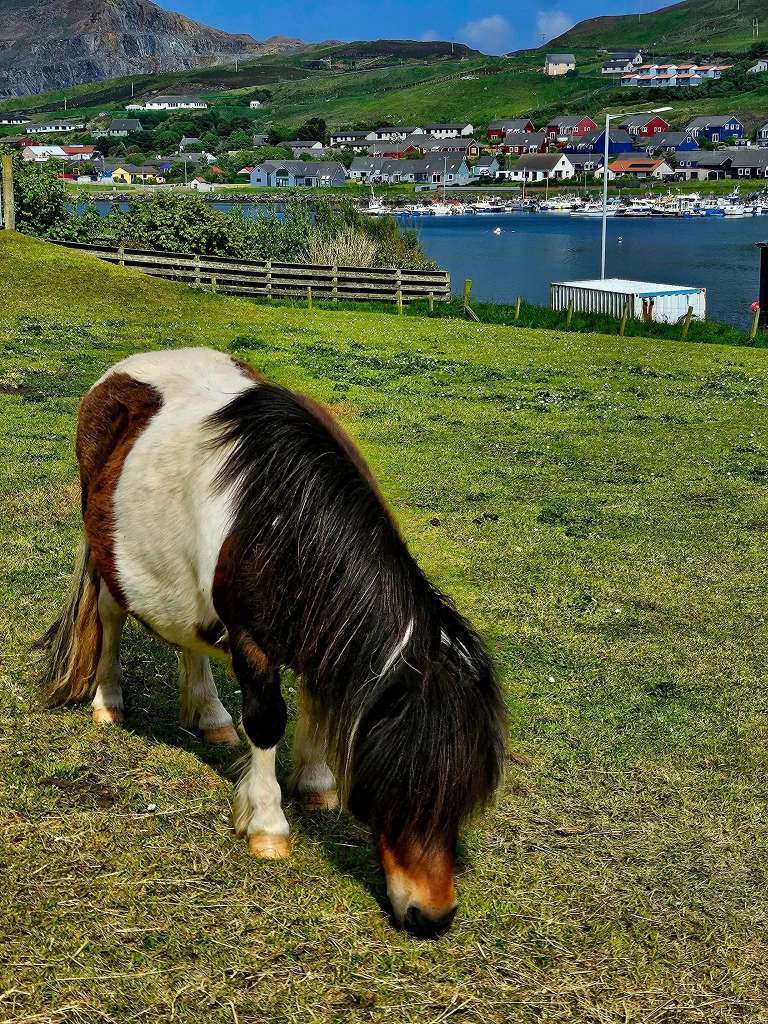
The shore excursion takes us to mingle with Carol’s Shetland ponies, see the fascinating World War II collection at the Scalloway Museum and look at an ancient broch, or round stone building from the Iron Age at Old Scatness, a layered archaeological site inhabited for millennia. There’s a ‘bonus’ Viking hearth and floor to be seen. We drive past Jarlshof and I press my nose and camera to the window. The longhouse is clearly visible. Everything is made of stone because there are and were no trees for timber on Shetland.
Orkney’s countryside is also treeless, dotted with cows rather than sheep, striped with drystone walls and strewn with layers of ancient ruins which have led to its designation as a UNESCO World Heritage Site. The shore excursions have booked out early, so I organise for the three of us to join a small-group tour with Go Orkney Tours at Kirkwall, the Orcadian capital.
The knowledgeable Antony takes us to some awe-inspiring Neolithic sites. We pass Maeshowe, but apparently it’s closed at this time. It’s a chambered cairn and burial mound, later ‘interior-decorated’ with rune-graffiti, some left by a group of Vikings who sheltered in the tomb from a blizzard in 1153, according to the Orkneyinga saga, and some left by Norwegian crusaders in 1095. The 30 inscriptions found in Maeshowe, make it the largest, and most famous, collection of Viking runes known in Europe. I’ll have to return to Orkney to see it.
Kirkwall’s the world’s best-preserved Norwegian Viking settlement, Antony tells us. He points out the layout of long thin plots and gable-end shops and limestone houses. St Magnus Cathedral dominates the skyline of Kirkwall and is the oldest church in Scotland, having been built by St Magnus’ nephew during the time when Orkney was under Norse rule.
We fulfill a non-Viking bucket-list ambition for me with a visit to Skara Brae and also visit the Ring of Brodgar and the Standing Stones of Stenness, thought to be the oldest standing stones in Britain as well as the Yesnaby Cliffs, the Churchill Barriers and the beautiful Italian Chapel.
Edinburgh
Unlike the Vikings, cruise-ship tourists are welcomed by the friendly Scots. We’re piped ashore from the tenders by a kilted duo at Queensferry before we catch the bus into the city.
Edinburgh’s one big outdoor museum in and of itself. I return to some of my favourite nerd-out haunts—The Writers’ Museum and The National Museum of Scotland, which houses the Lewis chessmen, handcrafted in Norway from walrus tusks and whale teeth in the Twelfth Century, and exposed by the sea in the 1800s near Uig in the Western Isles. The Vikings, I read at the museum, saw Scotland as the land from which to obtain slaves, but eventually they built castles and established the clan-leadership system throughout the Islands and Highlands. Talking of Castles, we visit the very crowded Edinburgh Castle as part of the shore excursion before being left to have some free time.
Ominous clouds gather as we’re scoffing lunch opposite Princes Street Gardens, and then the rain starts pelting down, so we scuttle back to Queensferry and the ship early.
Newcastle-Upon-Tyne
The Jorvik (=York) Viking Centre, with life-sized dioramas depicting Viking life, and the display of some eight hundred archaeological finds, is the highlight of the excursion to the quintessential Norman city. Talk about interactive! It’s unique in that the dioramas emit carefully matched smells; olfactory nuances range from the relatively pleasant (fresh pine, seawater, fruits and nuts) to the unabashedly stomach-turning (blood and gore, mud and smoke from burning settlements). I learn, by googling that, because they had a more nutritious diet than the people they subdued, Viking raiders didn’t smell as bad as the English locals at the time. I am less abashed about my Nordic Diet. I really wanted to do that excursion, but it was booked out, so we go to Durham Cathedral instead.
The bus leaves us at the bottom of the steep town of Durham, near the River Wear which is carrying quite a flow of water and the guide leads us up through the cobbled laneways. A Norman Castle sits beside the cathedral, which was established by wandering monks searching for the right place to bury the bones of St Cuthbert of Lindisfarne, and both go back over 1000 years. Well worth the trip.
Day 14: Return to Copenhagen
George is an unpretentious English-speaking guide whose knowledge and passion enrich the shore excursion to Roskilde Viking Ships Museum. He casually lets slip correct pronunciations of words such as ‘Valhalla’, ‘Odin’, ‘Asgard’ and ‘Midgard’ which apparently are lifetime whoopses for me.
We walk around reconstructions of five Viking vessels retrieved from the fjord and take in a summary demonstration of how these ships were made. The oak for most of them came from Ireland and had to be cured in seawater to preserve it. Some were warships and some were cargo ships, but they were all scuttled at the shallow entrance to the fjord, making navigation difficult for enemy ships.
There’s a clip about the navigation techniques of the consummate Viking seafarers—stars, birds, ocean currents, the trajectories of killer whales and the position of the sun in the sky. The Vikings also devised a unique rudder, which was fixed to the starboard stern of the craft. Since the Norse word for a steering board was ‘stjornbordi’, the rudder lent its name to the starboard, or right, side of the boat.
George also leads our group through Roskilde Cathedral where the monarchs of Denmark, called ‘Christian’ and ‘Frederik’ alternately for centuries, are enshrined, and regales us with anecdotes about many of the occupants of the ornate sarcophagi in its alcoves, anterooms and chapels. There’s also a height-charting post in one of the crypts where monarchs, including Queen Mary, have cut their tallness grooves.
Days Sixteen to Eighteen: Return to Norway
We glide up the scenic Oslo Fjord over breakfast. Seals lounge confidently on the shores of several islands. They provided the Vikings with clothing, footwear and rope for rigging, as well as high-nutrient food.
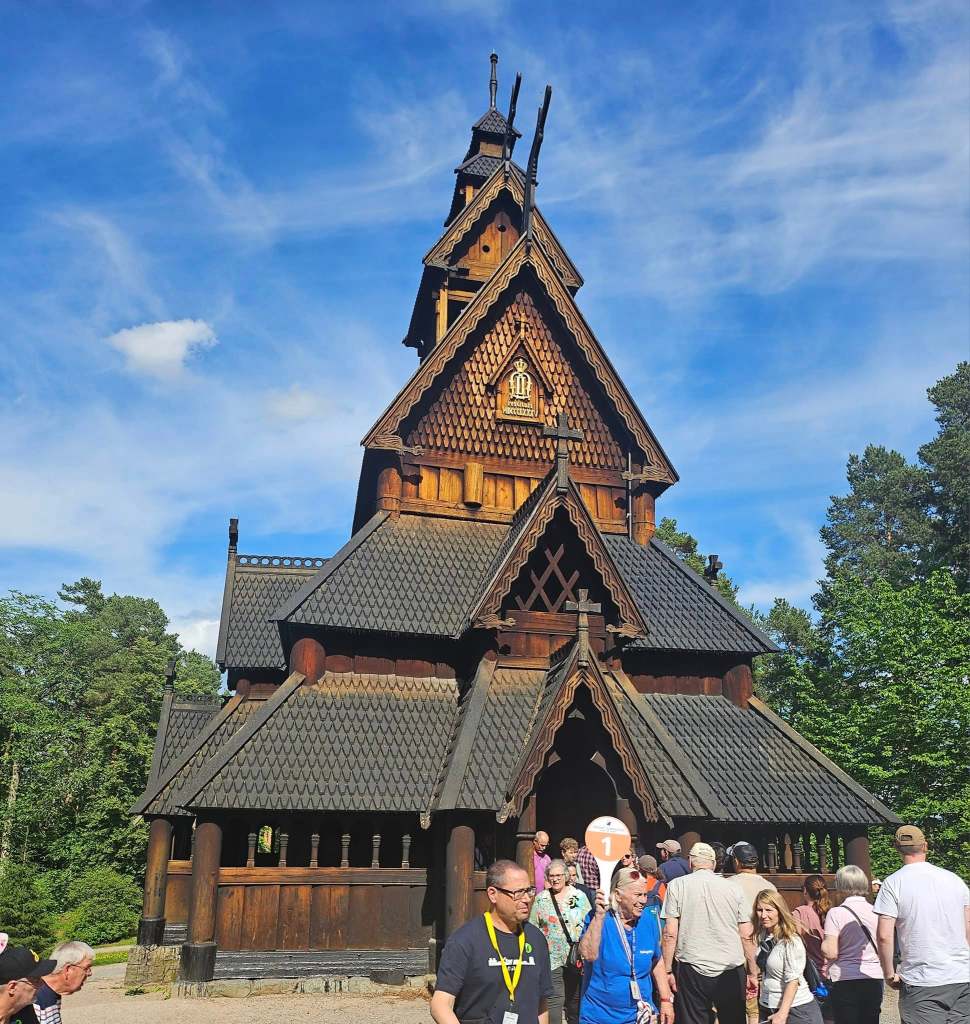
We’re booked on a seven-hour hectic taster tour of Norway’s capital. One would need at least a day to fully appreciate just the Gustav Vigeland Sculpture Park. We visit the a ski-jump and the Norsk Folkemuseum where the centrepiece is a huge ornately carved stave church, once again without windows.
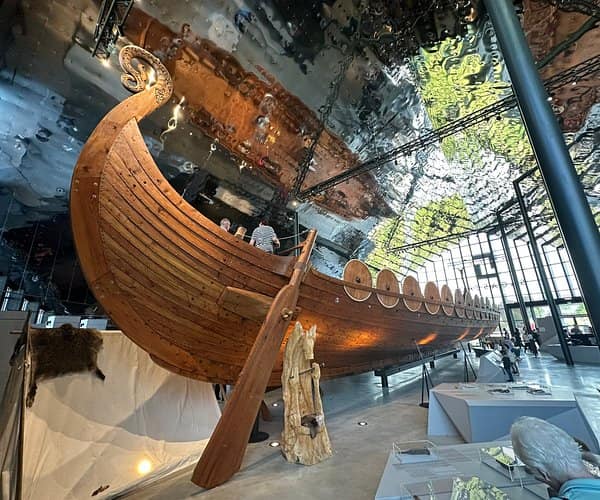
The Museum of the Viking Age has the world’s most important collection of Viking artifacts, many of them taken from The Oseberg Burial Ship built around the year 820. Carvings wind along the ship’s bow and end in a dragon’s head. Such an ornately decorated burial ship was for members of the aristocracy only.
In Nordfjordeid, we walk to the Norwegian Fjord Horse Centre to meet descendants of the compact, dun-coloured horses that the Vikings used to take in their longboats to work for them; and to eat on festive occasions.
We also visit Sagastad, a combined knowledge and activity centre located beside the fjord in the centre of the mainly white weatherboard town. We board a replica of the largest Viking funeral ship found to date—the Mycklebust Ship— and try on green and brown pinafores made of handwoven wool and flax. Men try on leather tunics and trousers of the same materials and reindeer- and seal-skin capes tied at the throat with leather thongs. Interestingly, real Viking helmets did not have horns.
Days Twenty to Twenty-one: Iceland
In northeastern Iceland, Akureyri is still enjoying snow. Shore excursions to the hot-springs Myvatn region, Dettifoss waterfall, Godafoss waterfall, and Asbyrgi canyon are phenomenally expensive, so we walk into town. It’s beautiful, painted mainly white and primary colours and with cobblestone streets. We have a frightfully expensive lunch of black pasta made from volcanic ash at Centrum Kitchen and Bar and spend upwards of an hour perusing the books and baubles in a big-butt bookshop called Penninn Eymundsson.
Further up the street, there’s a pervasive ‘fishy’ smell where crusty flags of the highly toxic Greenland Shark, flutter from a line in the icy breeze. When their Viking forebears settled the island centuries ago, the shark, which is abundant in the icy waters of the North Atlantic, became the main staple of the island. The problem with the Greenland shark, other than the fact that it is fairly ugly, is that the meat is toxic to humans.
At the time, it was one of the only sources of nourishment for the island’s small population, so to conserve as much food as possible, the resourceful Vikings developed a fermentation and drying technique to purify the poisonous shark meat.
Our final port before the cruise ends in Reykjavik is the town of Ísafjörðurin the West Fjords district. It was founded in the Ninth Century by a Swedish Viking called Helgi Magri Hrólfsson. There are rich sagas about the peace-loving Vikings who settled this area. Not our heritage, so we take a shore excursion touted as Avalanches and Arctic Foxes.
We pull over several times to look at spectacular but stark scenery, such as Valagil—a spectacular ravine, complete with mighty waterfall and made from layers upon layers of ancient lava. In the village of Suðavik, the site of a tragic avalanche in 1995, is a memorial site/playground called Raggagarður.
At a tiny church (with windows!), we’re treated to a performance of traditional Norse songs. I wander around the graveyard.
The grave of most significance is outside consecrated grounds. The last execution in Iceland was on January 12, 1830, when farm servants, Agnes Magnusdottir and Friðrik Sigurdsson, were beheaded in nearby Vatnsdalshólar, accused of murdering two farmers in 1828. The modern saga’s related in the haunting historical novel called Burial Rites, by Australian, Hannah Kent.
Behind The Arctic Fox Centre, where we try Icelandic ‘Happy Marriage’ cake (tasted of cardamom and was chewy with rolled oats), we gawk at two foxes, whose darker summer coats are growing in through the white. They won’t stay still for an Instagram shot. Inside is a more photo-friendly taxidermy display. The foxes, Iceland’s only native terrestrial animals, survive in temperatures of minus seventy degrees because of their dense, warm fur, which Vikings used for clothing, bedding and as a valuable trading commodity.
The resilience of Arctic foxes is up there with that of the Vikings. Being ‘Viking’ was an occupation—not an ethnicity (that would be Norse)— of brave seagoing journeys in search of adventure, silver plunder and new resources. I inhale the crisp Nordic Air. Ocean voyaging’s in my genes. Cruises are the modern way to collect experiences rather than plunder. And I’ll even drink to that. Skål!
The writer travelled on Nieuw Statendam and flew on Thai Airways at her own expense.
 Margaret R Kelly
Leave a comment