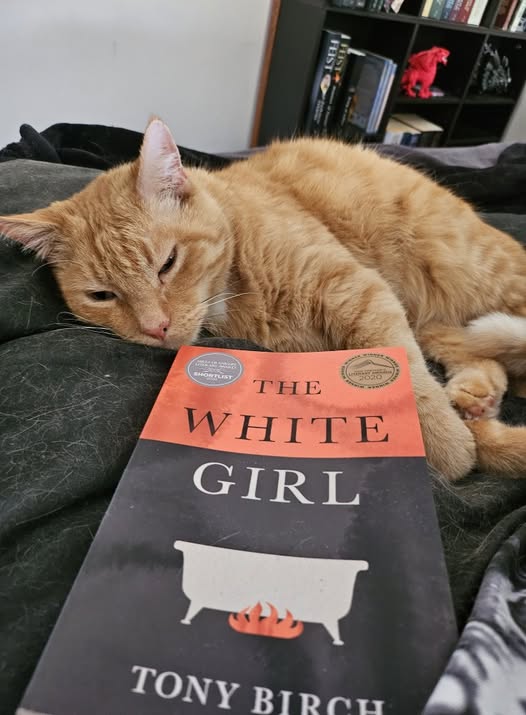
The story revolves around Aboriginal Odette Brown, a resident of the fictitious town of Deane since childhood. Deane could be in western NSW or Queensland or maybe Victoria. The only clue readers get is that it has a river which has dried up because of the activity of white people.
It is probably the late 1950s or early 1960s. Odette cares for Sissy, a granddaughter conceived most likely through rape by a white pastoralist, possibly Joe Kane, for whom Odette once worked as a domestic servant.
Odette’s daughter, Lila, traumatised by her violation and unable to cope with life as a mother, has fled to the big city, leaving behind Sissy, the ‘white girl’ of Birch’s title.
There’s a long (and rather boring) build-up till we get much ‘action’ in the novel, but I can see that Birch is trying to create a context for those of us who have been sheltered by not living in an era of individual and systemic racial discrimination.
It’s a multiple quest. First, to the city for a desired reconciliation between Odette, Lila and Sissy so as to prevent the new town cop, Sergeant Lowe – state-custodian of all Aboriginal people in his district – from taking (white) Sissy from her (black) grandma carer. Second, to escape the bullying of Aaron Kane, one of Joe Kane’s sons.
There’s a deep and fundamental chasm which separates the lives and experiences of Aboriginal and white Australians, both in terms of their rights and treatment by the government, and how they are framed in the public consciousness. Not only do the white residents of the area possess freedoms that their Aboriginal neighbours are denied, but they are also viewed as deserving of this unjust privilege.
In speaking to contemporary readers, it is clear that Birch wants us to redefine our understanding of racism beyond the bounds of individual beliefs and actions, and instead consider the ways in which societal and cultural systems of authority systematically oppress and marginalise people based on their race, leading to far more devastating and long-lasting impacts. And it is not just Aboriginal people. There is a Jewish doctor in Deane and ‘Auntie Millie’ is married to an Afghan camel driver.
By far the biggest source of tension throughout the text though is the ever-present threat of Sissy’s forced removal from Odette. From the mid-1800s to the 1970s, both federal and state governments forcibly removed thousands of Aboriginal and Torres Strait Islander children from their families and communities, resulting in what we now call the Stolen Generation.
Even when Odette gets an ‘exemption’ to give her extra rights, it is built upon certain restrictions which function to further dispossess and disconnect Aboriginal people from their communities and identities. In a fundamentally unjust and unequal society, the law punishes marginalised people, even when it claims to help them.
Birch’s writing is simplistic without flourishes, but I can see that this is to get his description of a shameful continuation of colonial oppression across to contemporary readers.
I find my own culpability and understanding of my place here hard to face, but the bottom line is that all non-indigenous Australians, no matter whence their ancestors came, benefit in some way from the way this place and their identity was taken from its original custodians.
 Margaret R Kelly
Leave a comment