—Kurt Vonnegut
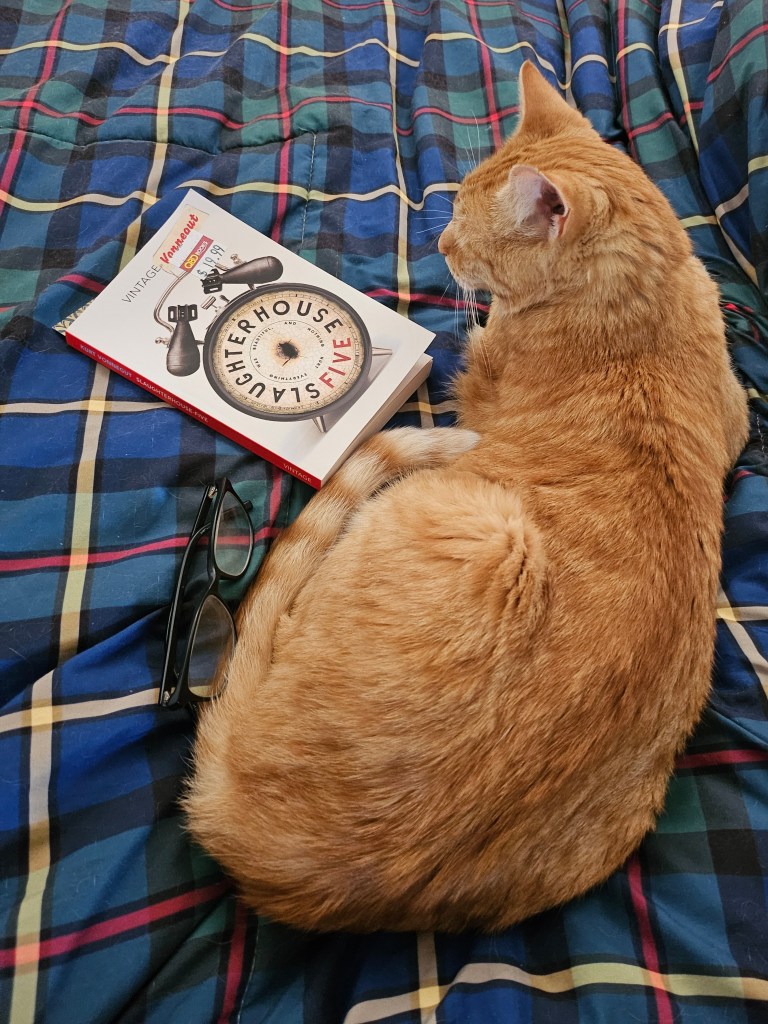
When I first read this novel, back when I didn’t have grey hair, it was marketed as ‘a classic of Science Fiction’. I read it because I liked science fiction, without really understanding the context of the novella, and was bitterly disappointed. Stephen King, I will point out, was also marketed as ‘Science Fiction’ back in the day and he was my favourite author. King at least usually sticks to the conventional narrative arc. Vonnegut, in this book, doesn’t.
Does that make it ‘Literary Fiction’ with a character arc? Not really. It’s one of the weirdest books I’ve ever read structurally, but not in a bad way. It jumps about in time and between reality and what seems very real in the mind of the protagonist but isn’t. I decided to revisit it because I recalled it as an omniscient narration of the lived experience of a ‘mad man’ (and that’s something I’m developing in my writing).
Now, if I had to classify ‘Slaughterhouse-Five’ into a genre, I’d gingerly drop it into the maelstrom at a crossover point between historical fiction and speculative autofiction and see where it spun out because I’d have no idea what to do with it otherwise.
At a purely literal level, it comes across as speculative fiction, but, as with so many books labelled ‘classics’, if you get your head around the Zeitgeist at the time it was published, there are deeper themes.
Billy Pilgrim is a misfit from a fictitious town called ‘Ilium’—UGH! Through a string of disjointed events, Billy ends up as a prisoner-of-war living in an abattoir, or slaughterhouse, in Dresden, in the east of Germany, when it is bombed, some would say punitively, by The Allies in February, 1942.
For context, Dresden was not really involved in the German war production or industry. Part of the reason for the bombing was rooted in anticipation of post-war hegemony. Fearing what a Soviet superpower might mean in the future, the US and UK were, in essence, intimidating the Soviet Union as well as Germany. I think … I was never a shining star in history classes where you had to think critically. This would have been the lived context, taken for granted when Slaughterhouse-Five was published.
Slaughterhouse-Five came out in 1969. After World War II (WWII), the popular narrative about THE WAR was that it was a ‘good war’ and fought fairly. The image of the war was one long John Wayne movie (although, ironically, John Wayne didn’t serve in WWII, which was unusual for Hollywood leading men at the time).
Whenever ‘we’ (allies of the US) fought, the popular myth went, the cause was just and the objectives were honourable and good. Anything that detracted from this narrative was pretty much ignored. Post Traumatic Stress Disorder (PTSD) was not recognised and Vonnegut appears to be trying to ‘Show not Tell’ it to readers in that era.
The novel begs for critical analysis as Billy Pilgrim’s ‘life’ jumps around all over the place chronologically. He even supposedly gets abducted and taken to another planet as a zoo exhibit for aliens who look like upturned toilet brushes. I think Vonnegut’s point with this is that, far-fetched as this seems, Billy is treated better by the aliens than he is by his fellow human beings.
Oh, the power of educated hindsight! PTSD is causing Billy to dissociate into other times in his life and to settle for what comes his way rather than make empowered choices about how he interacts with the world. The ‘omniscient narrator’ perspective gets across magnificently the way in which Billy lives with a complete blanket of numbness and emotional suppression. It’s a survival tactic.
Understanding all this and seeking to engage with the novella on a metaphorical level rather than at a literal one, I got much more from my reading of it this time round.
By the time the generation that fought WWII was in their 40’s, their kids had started fighting in Vietnam. I was in Second Grade at school and I still remember the protest marches.
What I was too young/naiive to grasp when I read the book the first time is that the political/cultural fight at home was the real reason the Vietnam war was ‘lost’ by the US and its allies. While Aboriginal rights was a huge issue here, white suburban kids also protested in the streets in both the US and Australia, and for once they were the ones getting assaulted by the cops. At one point 500,000 people descended on Washington in a protest to end the war. This would be the equivalent of three times as many today. In 1969, the pro-war faction was beginning to lose the hearts-and-minds battle significantly.
Into the mix of sentiment about war came Slaughterhouse-Five. This was a book written not by a member of the generation protesting, but by a WWII soldier, taken prisoner in the Battle of the Bulge. No one could impugn this man’s bravery or his experience—he’d been in the worst WWII had to offer. The picture he painted was of the insanity of it all; not a picture of inevitable triumph, but of personal defeat and futility in spite of victory. For the generation that fought WWII, this was heresy.
So in the battle between pro- and anti- war factions that continues until this day, Slaughterhouse-Five is maybe one way in which critical thinking about war came into the American mainstream.
 Margaret R Kelly
Leave a comment