It’s easy to see why many Impressionist artists flocked to Normandy to find inspiration: the lush landscapes and quiet serenity of the countryside, just a short schlepp away from Paris, would provide the perfect setting to paint in peace. No doubt they also nibbled on local cheese—the iconic Camembert, the smooth Pont L’Evêque, the pungent Livarot, or the adorably heart-shaped Neufchâtel. I’m dairy intolerant and not at all artistic but am there to soak up ambience. The fairytale villages of Normandy combine picturesque structures with surrounding natural beauty to create scenes which I scramble to capture on my camera phone with a total lack of restraint.
My four-night visit to Normandy, in the north of France, is a fortnight after the eightieth anniversary D-Day celebration/commemoration on June 6th, 2024. Normandy is also famous for its beaches, the stunning island abbey of Mont Saint-Michel and the departure point for William the Conqueror’s invasion of England in 1066. If you can’t eat the cheese, a slightly pre researched and subjective immersion in several points of history is nearly as satisfying.
My French (pen)friend of nearly fifty years, Brigitte, her daughter, Eve, and I set out in pouring rain and stupefying traffic to drive around Paris. It’s possible to catch trains to several points in Normandy and buses between others, and there are numerous tours with varying foci from Paris, but I would strongly recommend either driving from Paris if you’re game to try left-hand drive in city traffic or hiring a car in Caen or Bayeux. That’s of course if you don’t have a friend to chauffeur you safely out of the city. You’ll need an International Drivers’ Licence.
Our first stop’s a sculpture called ‘Sur la trace des Vikings’ beside the A13 autoroute. I have a particular interest in Vikings because a few years ago, on doing a DNA test, I, who thought my ancestors were purely English and Scottish, discovered that Norwegian forebears had contributed forty-nine percent of my ancestral genes. The French word ‘trace’ has the meaning of ‘trail’’ so it’s a faut ami—a false friend linguistically. The Viking trail through Normandy is way more than a trace.
The statue, mounted on a concrete wedge, is a shiny stainless sphere representing Earth, with arrows pointing out from the quadrant that vaguely corresponds with Scandinavia. The devastating Viking raids across Europe at the end of the 9th Century prompted Charles III (no, not the current one; aka Charles the Simple), the king of West Francia, to strike a deal in 911 with Rollo, the Norse chieftain who’d been raiding France as far inland as Chartres and laying siege to Paris. He gave the Duchy of Normandy to Rollo’s Viking gang in return for promising there’d be no more raids on the rest of France and for providing protection from other Vikings. Rollo thus became the first ruler of Normandy. He was also required to convert to Christianity, so was baptised and took the French name, Robert.
Rollo was born in Morë, across the fjord from Alesund in Norway. An inscription on his tomb in Rouen Cathedral states that Rollo was in his eighties when he died in 933CE. This means he was born in the middle of the 9th Century if my calculations are correct ( They often are). Rouen, instead of becoming a Viking-sacked ruin, became Rollo’s capital. His tomb effigy, lying decoratively on his coffin, is very long (6 ft 7). It was recorded that he was too tall to ride a horse and led all his raids on foot. Thus, he was known as ‘Rollo the Walker’. Every current monarch in Europe is descended from him as was William (Guillaume in French) the Conqueror. I possibly am as well.
I have ancestors with the name, ‘Sinclair’, who came from Northern Scotland. ‘Sinclair’, however, is a Norman habitational name, taken from the location, St Clair L’Eveque in Calvados, Normandy, where remains of the signorial castle can be found. The Sinclairs too, can trace their ancestry back to Rollo.
We cross the Seine, now much wider than in Paris, at Tancarville. Not a lot to see, apart from the impressive bridge and the turret of the 11th century chateau of the same name. Tancarville was the home of the Despensers (butlers) to the Duke of Normandy. Robert le Despenser was a Norman officeholder in post-conquest medieval England. My mother’s maiden name was ‘Spencer’ (a derivation) and the name, with its Norse lineage, is woven back and forth through the royal line of England. Yes, I am connected to Princes Harry and William through their mother, but she was also connected to royalty through historical liaisons, both clandestine and fairdinkum.
We stop in Colbosc to use the scrupulously clean non-pay toilets behind the Mairie (town hall). The loo’s next to the 14th century church, Saint-Romain-de-Colbosc. It’s free to enter most churches and cathedrals in France, and they always seem to be unlocked. Inside, there are worn floors, ancient boxy wooden pews, the churchy aroma of candles, furniture polish and contemplation and a devout simplicity. We catch ourselves whispering. As well as the near mandatory statue of the Maid of Orleans (Joan of Arc), there are statues of Sainte Therese, who was born and died in Normandy. She features strongly in the stained-glass windows in the church. You can always spot her as she cradles a bunch of flowers. Her superpower is manifesting the scent of roses, and, unsurprisingly, she is the patron saint of florists.
We drive on, through fields of vegetables, wheat, dairy cows (mmm—cheese!) and blue-flowered flax. The roads become narrower and clogged with harvesters and the buildings grander as we approach the town of Étretat. The architecture of the pretty seaside town is stunning, although it is necessary to park outside and walk for about a kilometre to the town centre. Mediaeval towns were not farseeing enough to provide streets to accommodate 21st-Century vehicles. Rainy Paris is four hours behind us and the sky’s a dome of brilliant blue. There’s a slight cooling breeze for which we’re thankful, as we marinate in our own juice thanks to the humidity. I’m in awe at the half-timber houses, some of which have seashells set decoratively into the plaster parts of their walls.
There are also a number of shops selling Calvados—the name of the region, but also Normandy’s libation of choice: apple-brandy or as the Normands call it, eau-de-vie, Calvados. Known locally as “calva”, the spirit is created when local apple varieties are fermented into a dry cider (also a tasty regional speciality) and then distilled and aged in oak casks for at least two years before becoming the smooth liquor best enjoyed either as an aperitif before a meal, or as a digestif during or after a meal.
We sample some local cider with lunch, the main meal of the day in France; so much so in fact, that Brigitte and Eve do not eat an evening meal. They are also vegetarian, so we opt for Lann-Bihoue Creperie. The name of the owner, Valerie Thomas, reads like she should be a typical Aussie, but she is actually a Normandy local with a robust Normandy accent that sorely tests my French from an Australian country university studied forty years previously. She emphasises the artisanal touch which is important if travelling in search of the heart of the locale. ‘Using local ingredients gives the food its soul,’ she says to me (she has to repeat it three times).
Be warned that the menu is just in French and the staff are not accustomed to speaking or hearing English. I’m hankering to try local delicacies such as Marmite Dieppoise, a fish stew originating from Dieppe, that includes a combination of fish, crustaceans, and molluscs, or Coquille St Jacques, scallops served right from the shell alongside shrimp and mussels with a gratin on top. There is a wide variety of galettes (buckwheat crepes). The vegetarians negotiate fillings while I opt for a trout and herby cream cheese galette (buckwheat pancake) without the cheese. Then—shock, stomach-horror— I find we’ve ordered crepes for dessert. I scrape the cream off mine, chug a couple of Imodium and take one in the gut for the team.
Étretat is at the heart of Normandy’s Alabaster Coast: white chalk cliffs carved by erosion into unusual shapes. That and the changing light attracted many Impressionist painters, such as Monet, Boudin, and Aubertin, who immortalised the cliffs in their paintings. You can visit the museum dedicated to their works, but we only had the afternoon, so chose to immerse ourselves in the sights they came to paint. It’s also worth noting that all the public toilets seem to be free of the Parisien 50-cent surcharge.
On one side of the town, La Falaise d’Aval, (the Cliffs of Aval) are decorated with a natural arch and a solitary ‘needle’, to which Brigitte once walked at low tide. It is topped by an 18-hole golf course from which the views promise to be spectacular. We catch a little tourist train (a ‘turf-turf’) to the top of the other cliff, La Falaise d’Amont. There are no guardrails to prevent a tumble to the English Channel below. It is topped by a genuine Norman Church, Notre-Dame de la Garde, which sadly is half-hidden by scaffolding and is not open for stickybeaking. Les Jardins (Gardens) d’ Étretat are though and we take a walk back down the steep hill through their neo-futuristic splendour. The main features are sculptures and manicured hedges. We can’t get out at the bottom, so climb back up the hill again to catch the return turf-turf. The driver, Christian, is a local and very chatty and opinionated in relation to politics. Brigitte and Eve are polite but non-committal.
We return to the car and it’s a short drive into the forest to find the B&B where we will spend the night, La Ferme du Manoir. I’m, of course, enchanted to find that the lane down which we drive is called ‘Route de St Clair’. We’re in ancestral stomping grounds!
It’s a perfect setting the forefathers chose. We’ve dormer rooms side by side upstairs in a side wing of the main farmhouse. Views of grazing horses and apple orchards out the dormer windows are priceless, there’s a bull roaring all night and there’re cats and dogs and peacocks just roaming around. Madame is nice, but Monsieur is, well, opinionated and pushy. They make their own rough Calvados firewater and he thinks it funny to substitute it for apple juice with our continental breakfast the next morning. He is also obsessed with Russians and learning Russian language and blames Ukraine for all the woes of Europe.
Finally escaping from M. Haveachat, we visit the picturesque town of Honfleur, where there are markets spread through most of the town centre selling clothes, craft items food and household requisites such as mattresses. It reminds me of Brugge. I buy a bottle of mid-strength Calvados as a souvenir for my long-suffering, cider-loving husband.
The Vieux Bassin (old harbour) is chockers with yachts and is surrounded by distinctive high, narrow, timber-frame houses of all colours. They overlook the dock on three sides and it is undoubtedly the most photographed part of the port town! The Church of Saint Catherine is (unusually from my limited experience) built entirely of wood. We also check out the ancient system for doing laundry in a series of channels and climb the hill to see the more traditional Church of St Leonard, the patron saint of prisoners. It has a magnificent neo-gothic façade and a hexagonal tower decorated with bas-reliefs of musical instruments.
We go next to glitzy Deauville, playground of the rich and famous. There are racehorses, casinos and a glamorous cinema festival, and of course, polo is big here. We go to the beach. It’s a long way across the sand to the water. All the stars have their own ‘dressing rooms’—art deco beach huts— along the beachfront boardwalk. There are giant letters, similar to those spelling ‘BRISBANE’ at Southbank, spelling the name of the town. It’s de rigueur to snap a shameless selfy at a place pronounced ‘Doh-ville’.
From there, we drive to Blonville-sur-Mer and have a late lunch at Le Grand Cafe on the main roundabout of the town. For me, this is fish and chips and a Tarte Tartin (caramelised apple pie). We walk to the beach past a yard called ‘Viking Autos’ with miniature vehicles not much bigger than pedal cars. It’s a happy, family-and-dog-friendly beach; like South West Rocks. This is a special-request place for me to visit. Once again thinking of Norman locational names, this town is the source of my maiden name, ‘Blomfield’. Long story about its devolution better told another time. There’s a house with a turret which I decide must have been that of Hugh de Blonville who set out to invade England with Duke William. I loiter to touch the essence of connection; buying fridge magnets at the Information Centre and taking dag-snaps on the boardwalk.
We drive past the topiary dinosaur which straddles the Greenwich Meridien and the line between Blonville s/ Mer and Villers s/- Mer; both on the sea. We stay at the Hotel Des Falaises on the Villers side of the dinosaur. It’s adequate but not particularly posh. We take a long walk along the beach and buy snacks from a small supermarket. I feel a deep DNA sense of belonging. The evening air is thick and hot, so we watch the glorious tangerine sunset over the ocean at after 10pm and hope to catch some sea breeze. I think of Hugh de Blonville’s family and wonder if they missed him when he embarked on his traditional Viking warmongering. Why would you want to go plundring England when you live in such a beautiful place?
The next day we visit the landing beaches for the D-Day invasion by the Allies. The five code-names for the landing beaches are: Sword Beach which was where the Scots contingent landed; Juno Beach— the Canadians’ spot, Gold Beach where the English contingent landed and Omaha and Utah Beaches where the Americans went ashore. I like their senses of humour. Neither Omaha or Utah in the US has a beach in real life.
We go first, however, to the wee village of Ouistreham (meaning Oyster Village). The suffix ‘ham’ is Saxon in origin and reflects that English settlers came back across the channel after the Vikings invaded according to Wikipedia. It’s Sunday and almost deserted, even round the little church which has a pigeon loft used for carrier pigeons during the War. The other side of town is thumping with the Festival du Littoral—a surprise event centred around a small red and white lighthouse. There are market stalls (mainly seafood and fish) and boats and lots of people with dumpy/stocky ‘Norwegian’ builds like mine. The gulls are celebrating with a seafood bonanza.
Bunting, British, American and Canadian flags and photos of soldiers to commemorate the 80-year celebrations are still on display above the streets. We visit the beaches in turn. There is a statue of a kilted piper called Billy Millin at Sword Beach as a tribute to the bravery of the Scots. Wreaths and floral tributes, mainly made of red paper poppies, still look fresh round its plinth.
The Canadian Memorial Area is decorated with flags and colourful wire sculptures and a decorative tank. There’s a narrow, rocky beach with a promenade in a town called St Aubin. Painted stones and the ubiquitous red paper poppies have been laid in memory of fallen Canadians. We take a walk up some narrow laneways which lead away from the waterfront and discover an artiste selling watercolour paintings from her garage; for cash—we only have cards and I refrain from saying, ‘Merde alors!’ out loud.. We return to a plastic beachside pavilion café for lunch. The menu is bilingual and I indulge in moules (mussels) a local delight. We have tarte Normande—an apple pie by any other name, but different from the previous lunch’s Tarte Tatin, even though it has apples too.
At Gray sur Mer, just past Juno Beach, there’s a commemorative sand-dune area with a stranded tank, a repurposed German bunker and a two-armed cross which is apparently symbolic of the province of Lorraine and General Charles de Gaulle who was born there. It’s where he came ashore on 14th June, 1944 from his exile in England with Marshall Montgomery, Winston Churchill and King George VI, and declared France free again.
We drive through fields of wheat ready to harvest and I realise that this is how Gold Beach got its name. It has steep cliffs in contrast with Sword and Juno Beaches. At Arromanches, beside Gold Beach, there’s a viewing platform to enable people to see the artificial harbours constructed so D-Day equipment could be brought ashore, and a massive vintage and veteran car rally.
Brigitte is particularly keen to show me the American Cemetery behind Utah and Omaha Beaches. She has tears in her eyes when she thinks of all the American mothers who lost sons for the sake of France’s liberty. Normandy American Cemetery and Memorial is located in Colleville-sur-Mer. According to the American Battle Monuments Commission, the Army constructed it on the site of a temporary cemetery for American soldiers in June of 1944. It was the first American cemetery on European soil in World War II. The 172.5acre cemetery contains the graves of 9,386 dead. Most of the fallen died on D-Day and the days of battle that followed.
The Walls of the Missing on the east side of the memorial enclose a quiet, semicircular garden. The 1,557 names of the missing have been inscribed on those walls, and it’s worth taking some time to see it. Sculptures and large maps describe the military operations that took place in Normandy and my eyes glaze over even as I try to make sense of them.
There’s a beautiful reflecting pool and a small chapel. To the north, rising above Omaha Beach, where the paratroopers landed, a table with a diagram of the beaches is available to help orient visitors. Vertical chalk cliffs mark the edge of the cemetery. The lines of austere white crosses are by far the most poignant aspect of it. One of the crosses marks the burial site of Theodore Roosevelt Junior. It’s sobering to think that the celebrations around D-Day were at such a huge cost. We join thousands of Americans for the afternoon commemoration ceremony and lowering of the flag.
In St Mere Eglise nearby, we stop to see an effigy of a parachutist hanging from the church roof. John Steele was a paratrooper with the 82nd Airborne Division. He pretended to be dead for two hours so he wouldn’t be shot by the Germans when his parachute became caught on the church steeple during the Allied invasion of France. Army jeeps are parked in the streets and there’s the first typical souvenir shop I’ve seen, obviously aimed at American tourists. Inside the church, stained glass dapples dance on ornate walls.
We stay at Ferme de Franqueville nearby. It’s an old farmyard made new and comfortably furnished and Madame seems more hospitable than our previous farmstay host.
UNESCO World Heritage Site, Mont Saint-Michel in France is set on a small rock island just off the coast where Normandy and Brittany merge. It used to be in Brittany, but then the River Couesnon, which marks the border between the two, changed course and Normandy now claims it. There aren’t many historical sites that trump Mont Saint Michel when it comes to settings! I’ve been wanting to visit it since the blurry black and white photos in my French textbook first captivated me.
We leave our lovely farmhouse after a huge breakfast and drive about two hours to visit MSM. The island’s towering abbey, which dominates the surrounding landscape, is one of the most captivating and recognisable landmarks in France, and its history and architecture are just as memorable. Its distant silhouette has sent pilgrims’ spirits soaring for over 1000 years. Isolated by the bay’s dangerous quicksand, disorienting fog, and mythic tides, it earns them nearly as many brownie points as places more … well,… pilgrimmy.
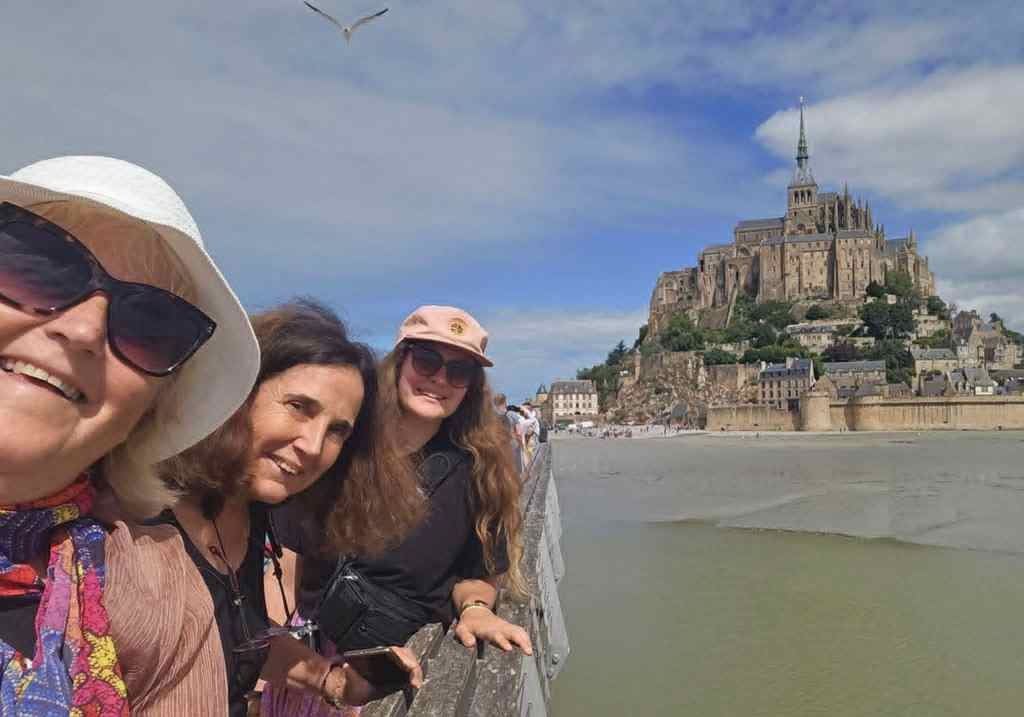
Suddenly, there it is, rising above the plain; floating majestically in its timelessness. I liken the experience to that of seeing some immediately recognisable other places in the world for the first time — the Pyramids, Mt Fuji, the Eiffel Tower, for example. Just drop-jaw wowness.
We draw close and are able to park the car and catch a shuttle in across the causeway to the main gate. Brigitte’s excited because last time she had been there, no water had been surrounding MSM, but today, it’s high tide.
The history and beginnings of the abbey are shrouded in legend, leading to its position of a significant place of Christian pilgrimage and worship. The story goes that the Archangel Michael visited the bishop of a nearby town in the early 700s and instructed him to build a church on the island, and you don’t exactly ignore an angel; ‘specially one who slays dragons. From 966 AD the church was developed into a Benedictine abbey, evolving across the subsequent centuries, particularly in the medieval times when several awe-inspiring monastic buildings were added to the complex.
The word “hermit” comes from an ancient Greek word meaning “person of the desert.” The closest thing to a desert in this part of Europe was the sea. Imagine the “desert” this bay provided as the first monk climbed that rock to get nearer to God.
The island became a famous centre of learning, welcoming some of the greatest minds across Europe, while simultaneously keeping out the royals from across the channel. They could never breach the ramparts, which, ironically, now open to around three million tourists every year. Many of the fine buildings which went up along the streets of Mont Saint Michel have been converted into boutique shops, crêperies, hotels and museums, though they still retain their old charm. Reminiscent also of Harry Potterdom. The shops and eateries, while grotesquely commercial on the surface, don’t strike you as such if you consider that the streets have always been a retail gauntlet for travellers. We eat pasta for lunch and follow it with a delicious lemon sorbet. I’m kind of getting used to filling up in the middle of the day.
Brigitte has bought us tickets to the see the abbey and we traipse up the 350 steps of the largely external staircase. I have recently had Covid and have to stop a couple of times to suck air. I don’t want to miss the boring gothic-ness—endless cold beige halls empty of furniture. It’s boring that is, till you consider the engineering involved. Most of the abbey is built on huge crypts under the rock and some of the supporting columns are thicker around than I am. I flounder onwards and upwards past sheer rock walls and creepers trailing colourful flowers. The view from the top is worth the climb, although it may be too literal to describe it as breathtaking.
Afterwards, we visit a rustic working windmill which grinds authentic flour from local wheat. We stay in a converted tack room behind a stable and go out again to catch a pastel pink sunset over Mont St Michel. Now, THAT is definitely breathtaking.
Famous as the “medieval city at the gateway to the D-Day beaches”, Bayeux is a town full of surprises. Its museums, its commemorative monuments, its medieval architecture, its craftsmen, its very (very) good restaurants… A city of art and history, the town is also home to the famous tapestry, a UNESCO World Heritage Site, woven in its imposing Notre-Dame Cathedral. ‘Notre-Dame’ is a popular name for cathedrals in France, eh?
Vieux-Bayeux is a delight of half-timbered houses and manor houses with turrets and the shop windows of craftsmen and delicatessens! The River Aure flows gently through the centre of town and I am here, however, to marvel at the Bayeux Tapestry which tells the story of King Harald, who was ultimately defeated, setting out to the battle of Hastings—the 11th Century 11th-century conquest of England by William the Conqueror, Duke of Normandy— embroidered on linen. It’s housed in its own museum which used to be a Catholic Seminary. Its sheer size (70m long) is the first thing that strikes me. It consists of seventy-five scenes with Latin inscriptions (tituli) depicting the events leading up to the Norman conquest and culminating in the Battle of Hastings in 1066. The textiles end is now missing, but it most probably showed the coronation of William as King of England.
It was beautifully embroidered with multi-coloured horses and ships, bright birds and mythical beasts. Many key characters are named. It is incredibly detailed and can tell us a large amount about the lives and the fashions of the Normans and Anglo-Saxons. Figures of ordinary people can be seen alongside their rulers, in an embroidery that took hundreds of hours to produce.
The detail is striking. There are bells at the throats of the hunting dogs. Each warrior’s coat of mail would have been a painstaking process of embroidered rings and borders, with a square at the owner’s neck. Look out for the spurs at the feet of the riders, the stirrups that keep them steady and the brooches at their shoulder or throat to keep their cloak from falling. Medieval helmets were made of bands of iron fitted together, even these are picked out in the tapestry, sewn with minute lines to depict each piece of metal. Trees, buildings and coloured bars break up the story and help build tension, leaving the audience wanting more. It’s like a carefully planned graphic novel.
Alongside the scenes of medieval war, politics and adventuring come the border scenes. These are some of the most visually impressive in the entire embroidery. Dragons, griffins, lions and deer prance across the piece. Some are part of the fables and myths sewn in the borders of the main panel. These allude to medieval ideals of morality, like the wolf and the crane whose moral is to expect no reward for serving the wicked.
There is much more to see in Normandy, but we are out of time and return to Paris having just touched the surface of its rich and turbulent heritage. Normandy is truly one of the most authentically charming parts of France and its incredible history makes it worth a visit.
 Margaret R Kelly