Scotland’s a land of monumental mountains and misty glens, castles with hidden stories, drams of whisky straight from the source, men in kilts, kelpies, selkies and Fay folk. It’s a mystical, time-shrouded lodestone which entices for many reasons, but the strongest for me is that my roots are tangled deeply in its rockiest, most wind-lashed soil: the Hebridean islands off the west coast.
I first felt the tangle o’ the Isles as a soft but persistent presence—an urge to flesh out names on my family tree into human lives. It lured me to a rosemary-scented churchyard in Bacchus Marsh, just outside Melbourne, to touch the past at an impressive sandstone wall marking the resting place of my great great great grandmother. I knew little about her except that she was from Scotland, that she had thirteen children, one of whom was born on the voyage to Australia aboard The Skelton in 1820, and that she herself was born on 18th January, according to her epitaph, in 1788, the day the First Fleet sailed into Botany Bay.
Ancestry.com provided more information, some of it conflicting, but Catherina Macleod’s life—her experiences and emotions—remained an enigma. She was from the Isle of Coll and was born Catherina Maclean, a daughter of the Laird who’d custodianship of the whole island. Eventually, after she’d emigrated to Van Diemen’s Land and her father had passed away, Catherina’s brother sold the Maclean title to Coll and emigrated himself to South Africa.
‘I have to get a picture of the family “chateau” for the loungeroom wall!’ my brother said when told that Catherina lived at New Breachacha Castle until she married Major Donald Macleod from the Isle of Skye, at the age of eighteen.
Most Aussies will tell you they love to travel, to discover and to experience faraway places, particularly if they’re descended from Vikings, as Catherina was. My dream, nay my focus, became to take an experiential and subjective ‘heritage trip’ to the source of my ‘Norwegian’ DNA—Scotland. Before packing my bags, I forearmed myself with Google and set goals of connection to and authentic understanding of what our ancestors’ lives were like.
My brother and I spent three days on Catherina Maclean’s tiny birthplace (official population 171) last November. Its western side often lashed by wild Atlantic storms, Coll is only twenty-one kilometres long and five kilometres across, but has a plucky, enduring beauty.
It was a nearly three-hour yomp to Coll from dreich Oban, on board the Calmac Ferry, ‘The Clansman’. My brother laid waste to a decently huge Calmac breakfast with haggis. I wanted to try the punny ‘Calmac and Cheese’, but it’s only served in the afternoon. It was brass-monkey cold on deck after breakfast, but our reward for resilience was to catch a mauve and pink pastel sunrise over the stern.
Coll’s main settlement is Arinagour – a tiny limewashed cluster of cottages spilling down a low rocky hill to a glaciated basalt harbour and wooden pier. According to a brass plaque, the houses in Shore Street, Main Street and High Street were built by the Laird—my four times great grandfather (jolt!)—in 1812 to house the workers on his estate. The main drag boasts a row of cheerful tiled rooves which are alternately red and black but probably would’ve been thatched originally. The general store is a prefab and the post office, which sells fishing tackle and wool from local sheep and has a Scots flag proudly flying out the front, is timber in a rugged shade of mission brown. The neo-gothic stone church, and the concrete hotel and bunkhouse add to a sense of precarious, make-do, hotch-potch existence. Wandering livestock relieve that by creating a rustic, casual ambience.
The day began to sparkle as we left the relative bustle of the ferry and drove through the township, passing only a lady on a bike who smiled, wobbled and waved. It was too early to check in, so we drove towards the rock-strewn, glaciated northern section of the island. A hen harrier floated above as we walked towards what looked to be the highest point. A scruffy hare with black-tipped ears jumped and ran from the intrusion, but otherwise there was a purity of silence. From the low summit of what we found was called Mt Hoch, we were afforded glimpses of deserted white beaches lapped by gin-clear waves. Coll has thirty beaches we later learned. The solitude and harsh openness were reminiscent of my time in the Outback.
Near the top of Mt Hoch is a boulder known as the Queen’s Stone or ‘Clach na Ban-righ’. It balances on top of three small stones, and was dragged into position by a glacier during the last Ice Age. The stone’s unique appearance has made it the stuff of legend. Some say it was thrown in a battle between giants, while others say it was used in Druid rituals.
The neighbouring islands of Rum (‘room’), Muck and ridgebacked Eigg (‘egg’), cracked the horizon. To the south, we could just discern our ferry chugging onwards to the Isle of Tiree.
My brother ran his critical-grazier’s eye over some Luing cattle—a hybrid breed two parts shorthorn and one part hairy coo, bred on the nearby island of the same name—and pontificated on the logistics of driving a fencepost into the skeletal soil, while I breathed the solitude and took a selfie on a stone bridge over a babbling burn which flowed fresh from a loch down to the shore.
In a sea-weathered churchyard surrounding the nearly buried ruins of mediaeval Killunaig Church, we found the poignant grave of Coll’s ‘last Maclean’. She maybe wasn’t a blood relative because back in the day, the system was that if you lived on and worked the land of a laird, you were entitled to use his surname.
We checked into the Coll Hotel, the island’s community focal point, where, returning from an afternoon walk through Arinagour, with glowing pink cheeks and salt-tousled hair, we kicked back in the bar with a ubiquitous ‘Irn Bru’ and then a gorse-flower gin produced by the boutique Isle of Coll Distillery.
It was Thursday—’curry night’— and the dining area soon filled with friendly Collachs, some of whom we’d met already during our constitutional: the barman was young Matt, who’d endured an earbashing about agricultural practices and sinking fenceposts, a lady who’d been feeding a tethered ewe with a bucket and a man walking his cat in a harness, for instance. The cat-walker had waxed liltingly lyrical about the 90mm gun from WWII which is aimed at Mull.
After our curry, relatively clear skies portended a wee spot of stargazing. Coll is designated as a Dark Sky Community by the International Astronomical Union. As there are no streetlights on Coll, the stars glittered as brightly as they do in the Australian Outback and the Milky Way oozed across the sky between them. The Aurora didn’t show, although there is always the possibility between late September and early March. We saw an animal that was quite like an echidna scramble-waddling up an embankment. Maybe it was a hedgehog.
We woke to a crimson dawn event, as the sun rose gently behind the mountains of neighbouring Mull, silvering the wakes of a trio of kayakers. Otters luxuriated in the tranquillity. It continued throughout breakfast as we watched a seal frolic in Arinagour Harbour. We asked our waiter about otters, and his face darkened. ‘They’re considered pests around here,’ he said. ‘They come ashore and steal chickens.
‘Red sky in the morning …’ he added as he served our breakfast. ‘There’ll be a storm tomorrow.’ My brother agreed— the sky was filigreed with mares’ tails— then demolished another full Scottish breakfast. I tried my first kipper.
Passing through Coll’s only thicket of trees, we drove towards the castles marked on the map— in a cove on its south-east (leeward) side. Ahead, was a stark landscape dominated by the greys of rocky slopes, the indigo of peat bogs and the washed greens of marram grass growing over white shell sand. This eco-system is only found on the western coasts of Scotland and Ireland and is called the ‘machair’.
The famous corncrakes, which nest in long grass, are safe on Coll because crofters don’t slash their pastures until these rare birds have bred and migrated to wherever they go in the winter. It was November, so there were none to be seen. but a huge flock of barnacle geese were grazing in a paddock. They lifted off, honking, en masse. It was majestic.
To our right, was a paddock where Eriskay Ponies grazed. King Charles, noted for his heritage-preservation activities, is a patron of the Eriskay Pony breed. The word Eriskay is Norse for ‘Eric’s Isle’. One of the remote Western Isles, it was where Bonny Prince Charlie first set foot in Scotland before launching the failed Jacobite Rebellion, and where one stallion, significantly named ‘Eric’, and a handful of mares saved the Hebridean breed from extinction in the 1970s.
Hebrideans wouldn’t have collected enough peat to keep warm, or seaweed to fertilise crops, without the ancestors of these sweet-natured, woolly, wee dudes. They once wandered unfettered by more recent fences, crofters just catching them with rope halters when it was time to work.
A cheery man on a tractor waved his thanks as we moved off the single strip of bitumen. At several peaceful farms, flocks of greylag geese grazed amongst chocolate-fleeced Hebridean sheep and English Leicesters (I took my brother’s word for that). The Viking ancestors had, naturally, snavelled the most fertile part of the island.
You can’t miss the twin castles rising in the distance. My heart beats wildly at the memory. The warm, fuzzy sense of homecoming was overwhelming.
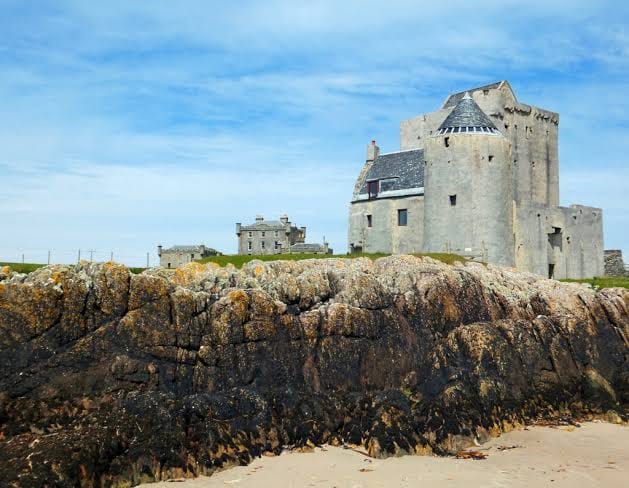
New Breachacha Castle, a boxy Georgian mansion, was built beside the old Norman castle in 1750 by Catherina’s great grandfather, Hector MacLean. His reason for upgrading the digs was that the old castle was said to have a malevolent ‘glaistig’ (ghost)—a ‘lump of a lassie’ with ‘white hair like a tuft of flax’. Catharina and Major Donald camped out in the old castle in the several years after their home on Skye, ‘Talisker’, had been taken from them (long story) before setting sail for a new life, but it wasn’t until the 1960s that it was restored and is now a private residence.
We bypassed the Breachacha Castles though, to pay our respects at Crossapol Bay, discovering a prehistoric standing stone, near the RSPB bird-watching reserve. Standing stones are known as ‘Na Sgialaichean’, which means ‘the tellers of tales’ in Gaelic; ancient monoliths, weaving a tale thousands of years old. The hum of time courses through your hands when you touch them.
Catherina’s parents, our four times great grandparents, are buried in a stone mausoleum south of Breachacha on a promontory overlooking Crossapol Beach. Alexander (gggg grand-dad) built it in 1815. The square tomb’s castellated and gothic, with a view worth dying for. Alexander and Catherine Maclean are feeding the lush grass well inside and a third mound marks the resting place of a trusted friend. A time-weathered collection of gravestones collapsing into the sea a few metres away, belong to farther-back ancestors.
At the castles, we clambered up to the low, rocky saliences that afford a view of the Hebridean Sea to the east, of Mull, the Skerries of Coll, Tiree, to the South and of the high misty ramparts of Skye beyond. A boat could be beached below the castles, so it’s probable that the Macleans travelled frequently to neighbouring islands. A casual group of cattle—shorthorns, Herefords and one Angus cow—were there now, picking through seaweed, shaking it vigorously up and down to get the sand off. ‘Including seaweed in a bovine’s diet reduces their methane emissions by about eighty percent,’ my brother informed me.
A remnant of a wall would be where the crofters hung kelp to dry over a smoking peat fire. It’s beside a tumbledown stone steading where they’d have lived in one end of the building while the animals lived in the other. A patch of lush green thistles, my brother’s nemeses in Australia, were somehow, a privilege to see in Scotland.
A lady walking a pushbike appeared. She had a right to be suspicious, but when we explained why we were nosing around, she introduced herself as Barbara. She lives in the other end of the Scotch-thistle Cattle Byre. Her end has a roof. She’s the caretaker of the New Castle and was quietly eager to show us inside.
The castle’s current owner is restoring it according to Hector Maclean’s plans. There’re places in the main four-storey ‘block’ where original beams and paintwork have been exposed, and original stairs and balustrades have been restored. These were places where I could touch Catherina’s life. Round the back next to the traditional langoustine traps, was a pile of 20th-century depth-charge mines pulled from the sea, which wouldn’t have been a part of Catherina’s world.
I finally understood what ‘being on country’ feels like. I closed my eyes, knowing that I was being watched by curious seals, their heads popping up out of the nearby inlet, and breathed the moist, briny air of Catherina’s ‘hame’.
We thanked Barbara profusely.
‘Haste ye back,’ she said with a smile.
 Margaret R Kelly