Cherry-blossom shots are the quintessential heart of the Japanese travel brochure cover shot, but Japan in cherry-blossom season is unlikely to live up to your dreamed experience if you limit yourself to the overtouristed areas of Tokyo, Kyoto and Osaka.
NARITA
In March 2025, our Jetstar flight from Brisbane landed at Narita Airport after dark. Rather than just head into Tokyo, my husband and I had decided to spend two nights in the quaint old township of Narita after which the Airport was named. We were surprised at how little it had been altered by proximity to the entry point of streams of international tourists.
In Narita Park, behind the big temple complex (Naritasan Shinsho-ji) which has the vermilion appeal of pagodas and mon (gates) to rival Asakusa in Tokyo without the overwhelming crowds, there’s a mass-planting of an earlier-flowering species of ‘sakura’ (cherry blossom trees). Narita also has a wonderful traditional shopping street where you can try the local delicacy, eel (ask for unagi) and watch master ‘slicers’ (I don’t think English has a word for specialised eel butcherers) prepare your dinner. You can also watch live performances by a trained Macaque (Japanese monkey).
From there we went straight through Tokyo to Yamanashi Prefecture, where I lived in the prefectural capital, Kofu, firstly as a Rotary Youth Exchange student and then studying at Yamanashi University.
*Arriving at Narita Airport early in the evening, we caught the free shuttle bus to Terminal 2 and snagged a taxi in the local ‘Chiba’ line, not the line of taxis going to Tokyo. We were able to pay using my Greater Bank debit card which doesn’t attract foreign exchange conversion fees. It worked out at around AUD$35.We could have caught the train, but we’re old, had heavy suitcase and were tired. We stayed at the quaint Narita Sando Guesthouse. Check-in was an honesty-electronic combination and we didn’t see a host over the time we were there. The beds were futons, but on a hard floor rather than tatami. Not recommended if you have a bad back, but good value at AUD $51 a night. All rates quoted are through Booking.com*
*There are two stations in Narita— JR Narita and Keisei Narita, operated by different companies. Google told us, as we sat munching on McGriddles for breakfast (pikelets instead of McMuffins), that the Keisei train would be most convenient for us. It was a local train and very crowded. Then we had to pay a catch-up fare at the other end to move across to the JR line at Shinjuku. If you are going to Kofu, we recommend the JR Line from Narita to Shinjuku. There is also a limousine bus from the airport.*
We’re waiting at Narita to catch the train into Shinjuku in Tokyo. I’m pumped about the annual Shingen Ko Festival, the following weekend. It’s the largest samurai re-enactment gathering in the world. (Guiness Book of World Records).
‘You should make a day trip of it if you’re still in Tokyo,’ I tell a young Sydney couple with whom we’re chatting. They have multiple face piercings and I wonder how much Japanese people cringe at that these days. I had pierced ears and had to take my studs out for school. The girls used to look at the holes in my lobes and exclaim and giggle in the same way they giggled when they asked if I had a ‘boyfriendo’.
‘Where’s Kofu? Isn’t it in Greece?’ the young man asks.
‘What’s there to do in Kofu?’ his companion wonders.
‘Same pronunciation, different spelling. It’s about ninety minutes west of Shinjuku,’ I say. ‘And fruit. Kofu’s the fruit-bowl of Japan. We’re going to a strawberry farm this arvo. There’ll be stone-fruit blossoms on all the hillsides.’ The girl’s ruby-studded upper lip curls. That gives me another idea.
‘Yamanashi Prefecture’s also Japan’s centre of artisan jewellery; everything crystal.’ I smile as I remember my host father, a third-generation jeweller, polishing each crystal individually on a tiny rotating spindle.
‘I’m not one for jewellery. What else’s there?’
‘Scenery. Hiking. Fresh air. Kofu’s a starting point for exploring around the base of Mt Fuji. You can sample sake and whiskey made from the purest naturally filtered water in Japan … Yamanashi wines are the most established and prestigious in the country.’
The young man’s eyes stop rolling when I add that there’s a Craft Beerhall which serves local and worldwide craft beers and matches them with international foods.
‘What’s there for vegetarians in Kofu?’ the girl asks at the mention of food.
‘There’re at least four vegetarian restaurants in the city centre along with the usual selection of Indian, Italian, Thai and fast-food chains. The aspect you’ll appreciate most after being in Tokyo is that the air’s free of the stench of overpriced Kobe beef. Oh, and Yamanashi has a specialty vegetarian noodle dish… It’s available at most Izakaya. They’re Ma-and-Pa drinking establishments that also sell food…’
UNIQUE RYORI (CUISINE)
The cleaners leave the train, line up facing us and bow in unison, ending my hopes of talking up ‘houtou nabe’—rustic, hand-cut noodles simmered with root vegies in a fragrant red-miso broth. Okumura Honten Restaurant does steaming bowls of authentic houtou nabe, perfectly complemented by their Yamanashi sake selection, traditionally served hot in porcelain sake-cups, or cold in generous shot-glasses.
Several other local dishes on the menu at Okumura would not suit vegetarians. They’re for courageous carnivores: ‘Torimotsu-ni’ —chicken giblets (or ‘guts’ as they were translated for us) in miso— and ‘Yoshida Udon’ —black noodles incorporating lava-flour from Mt Fuji and/or squid ink, liberally decorated with cabbage and horse meat.
GETTING TO KOFU
At Shinjuku, we board the JR line’s Azusa Express. (* We bought first class—green car—tickets online for about AUD$70 each and then collected them at a ticket machine scanning the QR code on our phones. You can buy tickets in 2nd class at the station using cash and they’re about AUD$40-50 each. You can also catch a Highway Bus from upstairs at Shinjuku Coach Terminal. It’s cheaper but takes much longer).
After three quick stops, the train climbs into the Southern Alps and I inhale my Zen. Like several of our Japanese compartment companions, hubs is asleep and exhaling his with a faint purring sound. Blossoming plum trees peek from the winding streets of traditional villages and the banks of meandering rivers, and bow-legged old-timers in sombre traditional work clobber shuffle along paths between rice padis. I’m approaching ‘home’ and there’s a warm-fuzzy build-up in my chest.
ACCOMMODATION
If you plan to visit Japan in March-April and stay at B&Bs, you need to book more than six months ahead. I didn’t, so our digs for the week are at The Washington Hotel Plaza, just a 15-minute yomp from Kofu Station. It’s a budget ‘business hotel’ providing the amenities of glitzy hotels, including wi-fi, a work desk and breakfast package, without the expensive trimmings. There’s an elevator, and also a coin laundry with ubiquitous vending machine. You don’t mind a more austere room when there’s a view of Mt Fuji from the window in every hallway. *Washington Plaza Hotel rates are about AUD$75 per night. I can also recommend Travel Inn Kofu at about AUD$64 per night.*
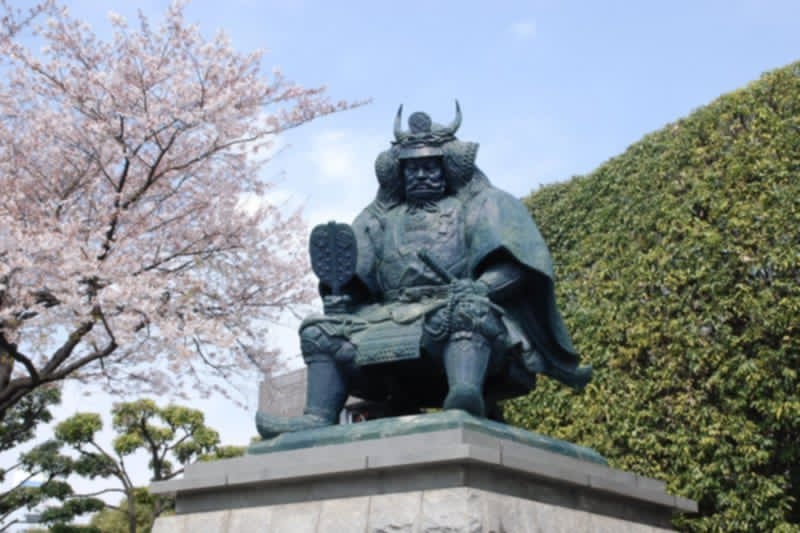
The first sight to greet me as I emerge from Kofu Station is a familiar one—the imposing statue that’s stood at the head of ‘Heiwa Dori’ (Peace Street) since 1962. It represents the powerful daimyo (samurai-period warlord), Takeda Shingen who ruled Kai Province—now Yamanashi Prefecture—during the 16th Century. His likeness is distinctly porky and he must have lived as high on the hog as he is on his pedestal today. He’s still the greatest ‘influencer’ in Kofu.
TAKEDA SHRINE
On the site of the former Takeda family residence, stands Takeda Jinja (Shrine). Some original stone walls and the moat remain, so it exudes a feudal ambience. Don’t miss the ‘princess well’ and the sacred ‘trident’ pine tree with the plaited rope round the trunk. Its golden needles come in rare bundles of three and are said to bring economic prosperity. Watch out also for the incongruous ‘Hello Kitty’ statue to the right of the entrance. Kitty-chan points the way to Homotsuden Treasure House which exhibits authentic weapons and armour from the Takeda clan, including a sword given to them by the Meiji Emperor.
Early in April, Takeda Jinja’s a popular spot to enjoy ‘sakura’ (cherry blossoms), with about fifty trees in the precincts and many more lining the entire two-kilometre-long Takeda Dori leading to the shrine from the north exit of Kofu station.
We catch a local bus to the shrine, past my Japanese Almer Mater. In Takeda Dori, as well as ogling the Sakura, keep an eye out for the bright blue kingfishers, the avian symbol of Yamanashi, decorating the power poles. Get off at the ‘Shuten’(terminus). At the shrine are couples having babies blessed and a few groups of elegant strolling ladies. It’s a contrast with the heaving crowds of Tokyo and Kyoto. There are other shrines and temples in Kofu, and for the most part, if there is no festival on, they are quiet and peaceful and looking around is free.
Other beautiful uncrowded Hanami (cherry-blossom-viewing) spots are along the Ara Kawa (river) and near Kofu Higashi (East) High School, eight minutes’ walk from JR Sakaori Station. During March, at fragrant Furoen Garden, two thousand plum trees and robust early flowering cherry trees flow pink down the hill. It’s also near Sakaori Station—four minutes from Kofu on a local train along the Chuo line and well worth a visit for the chance to see kimono-clad ladies enjoying the aesthetic. It’s a special occasion to dress up in traditional clobber and celebrate the aesthetic of Spring.
SHOPPING
You won’t find the tacky souvenir shops of the tourist-trap areas in Kofu. Kabutoya ‘samurai’ giftshop opposite the Takeda Jinja bus-stop sells Yamanashi-unique cakes, snacks and souvenirs, such as purses and manbags, made of ‘Inden’ deerskin leather, invented by Takeda Shingen to decorate his armour. It’s embossed with lacquerware motifs such as sakura, representing transient beauty, and dragonflies which symbolise victory and strength.
You can also buy Inden at other upmarket souvenir and specialty shops in Yamanashi including Celeo, above Kofu Station and several shops in the Kosshu Yumekoji complex to the north of Maizuru Park, and locatable because it has a replica of the town bell tower. Everything in the little shopping centre, from handmade stationery and artisan wines, to the unbeatable peach and grape pizza (which draws us back to Café Terroir for lunch several times), is locally sourced or made from local ingredients.
Brand-new Koedo Kofu Hana-koji Alley, is right below Maizuru Castle Park. It replicates Kofu as a bustling castle town during the Edo period (1603–1867) back when it was nicknamed “Little Edo (Koedo). Adjacent Kameyaza History & Culture Centre, named after Kofu’s biggest theatre at the time, hosts a variety of cultural events.
Home artisan shops are common in Kofu. Five minutes’ walk from our hotel, is Jam Kelly’s Mom. Look for a tiny white building with rampant yellow-flowered clematis growing above the door. ‘We built it ourselves,’ Tatsuya Matsumura tells us, beaming with pride. His wife, Megumi, makes all the jams from locally sourced fruit and berries from her garden. Yuzu (an indigenous citrus fruit) marmalade is a welcome sort-of westernising touch with the bread rolls in the hotel breakfast package.
ONSEN (HOT SPRINGS)
To (literally) immerse yourself in the Japanese aesthetic, traditional food and Japan’s geothermal bathing culture, visit Yumura Onsen Alley. Take the Number 4 green bus from the south exit of Kofu Station. The famous woodblock artist, Katsushika Hokusai (1760-1849), depicted the area in his work, and Takeda Shingen used to visit the 1200-year-old ‘onsen’ (Hotspring baths) to soak his battle injuries.
Most of Yumura’s ten hot-spring hotels accept non-staying visitors and you can buy bath passes which allow you to experience onsen for 500 yen each. Be aware though, that tattoos and body piercings (except single ear piercings recently) are not permitted in most onsen and ‘sento’ (public baths) in Japan, though some will let you cover them with a sticky plaster. This is due to the Shinto belief that the human body is sacred and should not be ‘desecrated’.
Hottarakashi Onsen, reachable by taxi for about $25 from Kofu Station is tattoo-and-piercing friendly. On a clear day, the views of Mt Fuji, on the border of Yamanashi and Shizuoka Prefectures, from the gender-segregated bath are worth the extra effort and cost to get there. It’s open early and closes late, so you can take in the sunrise or sunset naked.
SCENIC BEAUTY
As well as the famous places like the Fuji Five Lakes around Mt Fuji, Yamanashi is filled with places to appreciate nature. Continuing past Yumura on the No 4 bus for example, you will eventually arrive at scenic Shosenkyo Gorge. It’s a U-shaped valley where the Arakawa flows crystal-clear over tumbled rocks for about 8 Kilometres and you can follow the path of ancient pilgrims along the riverbanks. It’s better if you’re old and almost frail, like us, to start your pilgrimage at the top of the trail by disembarking at ‘Taki no Ue’ bus shuten/terminus. Visit Sengataki Waterfall and take the Shosenkyo Ropeway to a viewing platform for exciting views of Mt Fuji.
*Between the end of October and the end of March the bus terminates at the entrance to Shosenkyo (Shosenkyo no Iriguchi) and it is a 6 Km hike from there to the top of the valley. Still beautiful, but bear in mind that you have to also walk back. The other cautionary tale to this is that the only toilet on the way up is a ‘squatter’.
To ride buses in Japan, you pull a ticket from the machine near the entrance (back door) and pay in cash or using an IC card as you exit at the front. Prices are displayed on a screen above the windscreen. You can only get the IC card app on your phone if you own an I-phone. We had no problems withdrawing yen at ATMs to use for most transactions in Japan.*
My host parents had a crystal jewellery shop at Shosenkyo and there are still merchants selling crystals and precious stones and seasonal food vendors at the top. One food you must try is the ‘Edible Crystal Ball’ at Sennin Chaya Teahouse. The transparent jelly is topped with soybean flour and molasses and is surprisingly refreshing.
During your hike, if you take the long way up, detour to Kanazukura (‘money cherry’) Shrine. Due to the higher altitude, the pale yellow, ‘golden turmeric’ cherry blossoms there flower later in April. After your hike, catch the bus back to Kofu at the Gorge Entrance stop (‘Shosenkyo no Iriguchi,).
SAMURAI FESTIVAL
Shingen Ko Festival is three days of traditional performances, including dancing and taiko drumming, which culminateinthe re-enactment of the Koshu Battalion Deployment Parade, a pageantry of colour and sound. Twenty mounted warriors ride draughthorses in full Samurai battle tack (and led by their costumed handlers). They are accompanied by a thousand infantry warriors taking the parts of samurai who actually existed.
You can, if you’re over 18, no matter your nationality, gender or riding experience, go in a draw to ‘play’ one of the mounted warriors, and if successful pay twenty-thousand yen for the privilege. If unsuccessful, you get to be one of the costumed foot soldiers or an omikoshi-bearer for free. It’s a great honour to lead the parade in costume as Takeda Shingen, and this year it was a surprise to see a female actress was chosen.
I wore a happi coat and took part in the Shingen Ko Festival Parade in 1979 as an o-mikoshi-bearer. ‘O-mikoshi’ are portable shrines in which ‘kami’ (spirits, deities, sacred objects) are transported outside their shrines. The kami of Takeda Shingen has an ‘outing’ every year in the parade. O-mikoshi are solid wood and extremely heavy. Our team of about twenty bearers zigzagged down Takeda Dori yelling ‘Wa-sYOI! Yoi! Yoi!’ and occasionally tossed the heavy o-mikoshi high in the air. Fire trucks sprayed us with water to add to the chaos and ‘fun’ (pain?).
In 2025 I’m content to join the throng of cheering spectators and enjoy the other festivities,—in-costume ceremonies, battle recreations, musical and dance performances, and a variety of market stalls.
After the parade, fireworks flower over central Kofu. I feel someone tugging on my happi sleeve. It’s none other than the young couple from the Narita Express. They’re on their way to catch the last train back to Tokyo.
‘There’s a seven-storey electronics store that’s better than Akihabara right next to the Station and the karaoke bars,’ they gush.
We didn’t tell them we’d already found it and weighted ourselves down with gifts for our Gen Y offspring and that hubs had splurged on camera gear. It’s called Yodobashi Camera and is to your left as you walk from the south exit of the station.
Do yourself multiple favours and check out Yamanashi Prefecture.
 Margaret R Kelly