After three weeks in less touristed parts of Japan, my husband and I are bulleting through semi-rural Gunma Prefecture towards Narita Airport, laden with presents for the grandkids and a shared head cold. Blinking at passing scenery with dull, red eyes, over soggy masks, we’re afforded tantalising glimpses of iconic ‘sakura’—cherry-blossom trees. They’re scattered throughout the fallow padi-fields of the Kanto Plain and shake out their pink-tinged white eye-candy in rows throughout the streets of Tokyo.
Japanese cherry blossoms are the purest, frothiest, ‘blossomiest’ blossoms on Earth. The dainty petals are on point for a few days only. The diligent Japanese community-member celebrates refinement, elegance, transience and seasonal change in that hiatus before they perform their descending spiral dance to lie bruised on muddy ground.
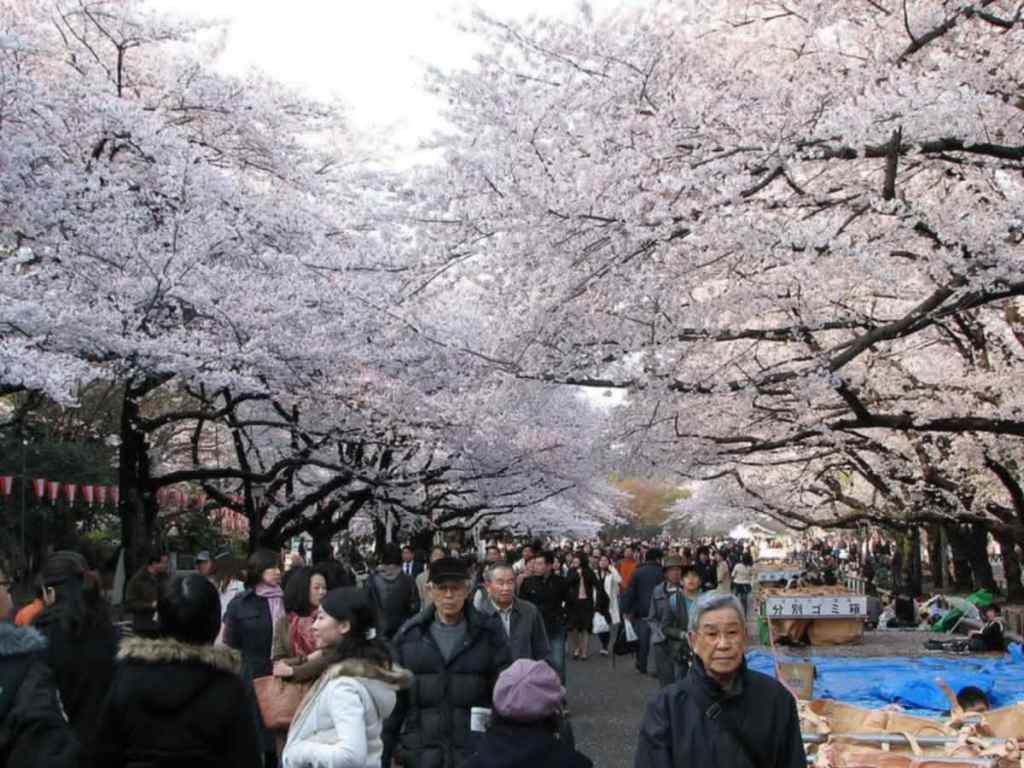
The Land of the Rising Yen in peak tourist season is not for the faint-hearted. We change trains at Ueno, where there’s a park, bursting with cherry-tree rapture-potential. It’s long been the most popular Hanami (flower-viewing) venue in Tokyo. We jam our cases into the lockers at Keisei Ueno Station and join the human throng to share the beauty.
Our progress to Ueno Park’s faintly reminiscent of surging crowds through the Sistine Chapel during Advent in 2019, which left me wondering where Peace-on-Earth had gone. The Japanese principles of respect and harmony have left Tokyo and are cringing in that same sad place in 2025.
Alas, selfy season’s in full swing in the land where public spaces are about harmony and group cohesion. The park’s a sea of smartphones wielded by loud foreign individuals addressing Instagram and Tik Tok audiences. Some Japanese people dressed in dark, blend-in clothes cringe among them avoiding eye-contact, seeing the cherry blossoms, but unable to enjoy them.
There’s a gusty, swirling ‘hanafubuki’ — a blossom blizzard— happening. Footpaths are presumably soft with fragile, sacred petals and the air faintly scented. It’s impossible to know because of the heaving crush of humanity. Anyway, the perfume’s bound to be a non-event through mucous-saturated masks.
It’s only later, when spotting blossoming trees from the relative comfort of the Narita-bound Keisei Skyliner, that I’m transported back to my first spring in Japan, forty-six years ago. As a sixteen-year-old exchange student, I’d been sent to the city of Kofu, Yamanashi Prefecture. Immersion in the Japanese culture and learning another language and way of thinking shaped my future life-choices. I blossomed myself in that year.
In early March, anticipations of and predictions about the opening of the local Sakura buds began at school and at home. As the weeks passed, these built to a crescendo, and by the end of the month, virtually every conversation somehow ended in speculation about the flowers.
When the first buds bloomed in Japan’s south, a media sakura hype-bonanza began. There was, and still is, a six-stage blossom cycle, and a whole vocabulary and symbolism associated with this frenzy. Television newscasters tracked the blooming hotspots on a pink map. There were thrice-daily updates as ‘Sakura Zensen’, —or the Cherry Blossom Line— slowly spread along the length of Kyushu and Shikoku, the southern islands, then moved through southern Honshu toward Kyoto and Tokyo (and Kofu).
The sakura is not the national flower of Japan; the chrysanthemum is. You can’t eat the cherries; although the blossoms are used in seasonal Japanese teas and sweets, and the current favourite, French macaroons. They add a fruity, faintly sweet, simultaneously faintly sour taste, almost like a real cherry. Sakura daiquiris are just a bit spesh too—cherry puree (obviously made from edible cherries), meets silver rum and lime juice. The Japanese art of shoving things on top decoratively is encapsulated with a hibiscus flower. The drink’s floral and fruity with a kick that supposedly screams ‘Welcome to Spring’ (or heartburn).
Because the custom of picnicking under blossom trees came from China and involved plum blossoms, they’re eschewed as inferior. Papa, my host father, however, took pre-fluent, pre-daiquiri me up into the orchards surrounding Kofu to share plum and peach blossoms. The pink and white tide foamed down the mountainside in one place. He also showed me the oldest flowering cherry tree in the world in Hokuto Village about 20 minutes from Kofu. It was propped up with so many wooden stakes that it was hard to make out the actual tree.
It’s called ‘Jindai Zakura’ and was about two thousand years old then. We spoke in hushed tones so as not to disturb the ‘kami’ (spirit). It was a humbling experience to think about touching a living thing that was so old; strictly thinking only. You weren’t allowed to physically touch the sacred tree. Hubs and I just visited Shingo in northern Japan where there’s a burial mound said to belong to Jesus. Jindai Zakura could’ve been a sapling when he passed by. If he passed by …
I happened also to return to Japan in the Spring of 2009. I recognised my, literally, old friend, Jindai Zakura in a media hype on TV. Even more stakes supported its twisted limbs. The ditzy reporter was in some sort of pink NASA suit. The whole tacky ambience reminded me of a telecast of Groundhog Day at Gobblers’Knob, like a game-show on steroids; a far cry from subdued Hanami parties.
One-hundred-and-eighteen cuttings from the old tree were headed into space to spend eight months circling the earth in the Space Station. I jumped up and down; excited in my hotel pyjamas. Hokuto is an isolated mountain village and not a lot of Japanese people’ve even been there. I had. It was my twisted brush with fame.
Out of all those tree-lets that went for a joyride, apparently only two took root. I guess old trees lose virility too. One of the offspring trees was named Uchu Zakura (Space Cherry) and now resides at another Temple. It’s special in that cherry blossoms usually have five petals per flower, but the Space Sakura has six. There’s some auspicious significance attached to the number 6 in Buddhism, so imagine the dropped jaws when that was noticed.
Cherry trees are sterile hybrids but seem to mutate a lot. There are blue sakura up in Kanazawa, and trees that bloom four times a year at some academic place in Tokyo where they copped some radiation. They’re the delicate wimps of the arboreal world. Whenever they have to be trimmed, gardeners cover lopped-limb stumps with wax to stop caterpillars and diseases having a chew, then wrap them in straw as an organic bandage.
If there’s a couple of days of rain and then warm weather, the sakura bloom all at once. Not just one tree coming into full bloom, either, but rows of trees, entire parks—deliberate plantings for the aesthetic. The artistic appreciation stuff all happens before the leaves unfurl. And — this isn’t me talking, I was often told — that it’s not even worth going out and sitting under a tree if the leaves have come out. There’s even a word for it, too. Hazakura— Leaf Sakura.
Anyway, back to 1979. One morning, after rain, virtually my whole bicycle route to school’d been transformed into a fairytale ride dotted with fragile, fleecy vistas of impossibly delicate white-and-pink blossoms. The perfume was subtle, but magnificent and breathtaking and there was the hum of many bees–exquisitely ethereal and sensual at the same time.
The incomparable flowers seemed to be everywhere–single trees in solitary splendour by the bank of the river, sometimes a festive procession, as along the avenue to Takeda Shrine, and in one place, at Castle Park, row upon row creating the effect of a fluffy pink cloud with the castle turrets rising above it.
Nighttime cherry-blossom-viewing, called ‘yozakura’, with the trees under-lit by big lights or hung with paper chochin lanterns, is uber-atmospheric, but not for the under-rugged up unless you like drinking hot sake. In my university days, it was cold at Castle Park in Kofu. I drank a whole thermos of hot sake and slurred my haiku badly. I prefer recalling the noontime spring air which is warm and soft and lightly perfumed.
Cherry blossoms so suit the Japanese sensibility that the word for flower, ‘hana’, has become synonymous with the cherry blossom itself. If you wander through a less crowded sakura site, the Hanami has evolved since its inception in the 16th Century … or it had in 2009. Maybe it’s devolved again now. Moatside at Chidorigafuchi— the Emperor’s Palace—there was room, in 2009, to sit under a sun-showered canopy of pink branches overlooking the blue rowboats on the moat.
All around me were groups of people representing the social spectrum of Tokyo. Young parents carefully spread colourful picnic blankets and pointed-out blossoms to chubby toddlers; even younger, ‘kawaii’ couples and girls in short, pleated skirts, slutty make-up, big fluffy, fake-fur coats and chains, preened and perched their meticulously coiffed pooches.
To my immediate left a half-dozen silver-haired citizens were sipping cans of beer, stabbing busy chopsticks into multilayered lacquer boxes bursting with sushi, rice balls, fried chicken, pickled vegetables, boiled eggs wrapped in tempura-fried fish paste, and seaweed salads. The red-faced patriarch of the group clapped his hands and announced something, and everyone erupted into almost raucous laughter.
High school girls in blue sportscoats and tartan skirts arrived and carefully unfolded a bright blue tarpaulin. They placed it ever so gently on the grass, then primly took off their shoes, arranging them neatly on the perimeter of the tarp. They set big backpacks around the edges to hold it down and then ceremonially knelt, opened their backpacks, and took out exquisitely wrapped strawberry and cream sandwiches, plastic bottles of green tea, and pinkly packaged slices of sponge cake. As they took neat bites and celebrated the scene with shining eyes, their giggles rose like blessings to the sky.
Sakura, illustrious for both their beauty and their brevity, have come to symbolise for the Japanese the haunting and glorious impermanence of life. Westernerss really knew little about Japan back in 1979. At the very beginning of my own life-long Japan-enmeshed journey, I saw this season of traditional group hysteria with wide, enchanted eyes. I wrote a letter to my sponsoring Rotary Club saying:
‘This communal celebration is at once social and spiritual, a glorious affirmation of the present in the effusive, efflorescent beauty–at once individual and collective–of the blossoms.’ I was a pretentious twat back then. I don’t believe ‘efflorescent’ is actually a word.
Now, more of that Japan journey lies behind me than ahead — and yet, forty-six springs later, the magnificent, transient Japanese cherry blossoms bloomed again—a reminder of cycles, living culture and renewal.
 Margaret R Kelly