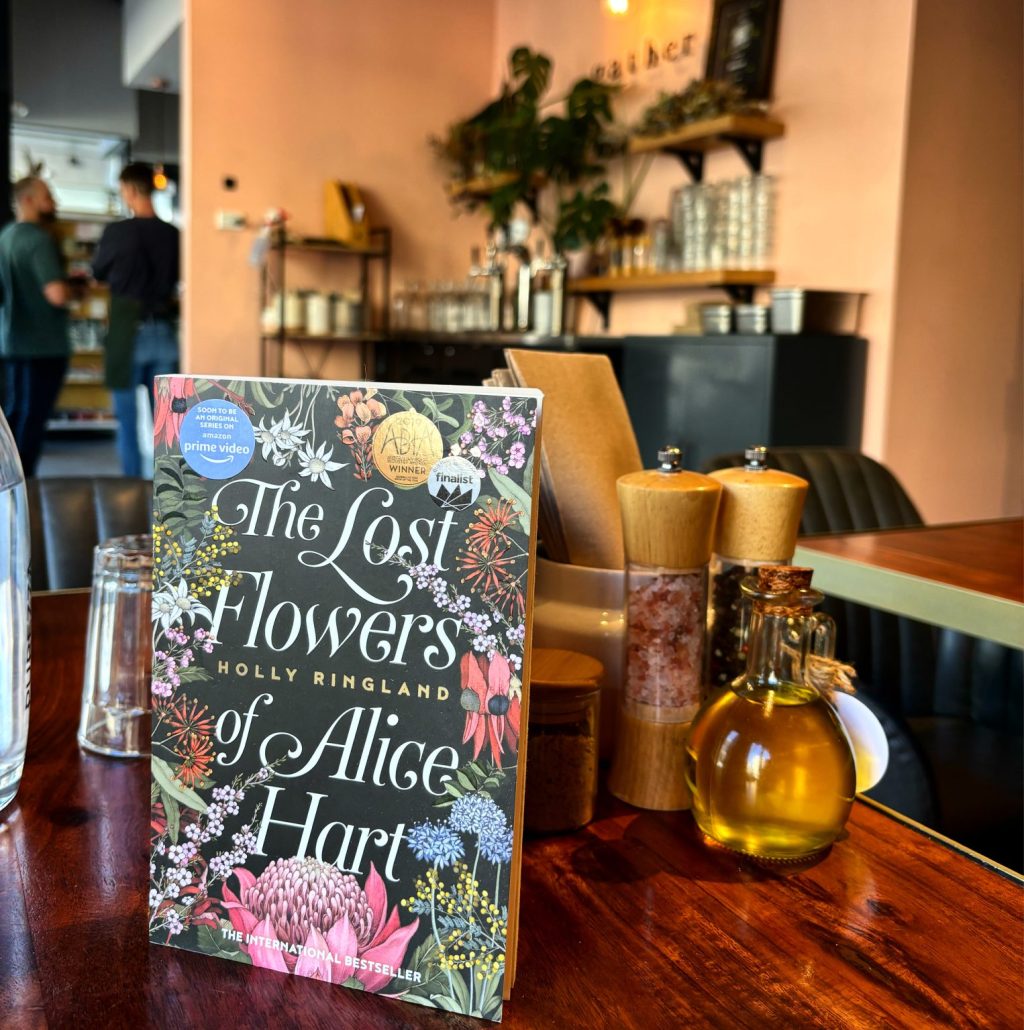
GENRE: FAMILY SAGA/AUSTRALIAN CONTEMPORARY FICTION
They shouldn’t sell this book at airports! It was a mistake to read this book on back-to-back long-haul flights and in airports because I ugly-cried and I said things like, ‘Oh No!’ out loud, attracting concerned looks from the physically perfect young Danish man sitting next to me. And I was more than jetlagged by the time my flight from Bangkok landed in Copenhagen because I kept sneaking just another chapter when I could have been sleeping.. Ringland has a way of writing that you can feel physically in your chest and leaves you gasping for breath. It’s spare but beautifully evocative.
The first part is delicate and dark, like a scary fairy-tale. Alice Hart’s journey begins at the age of nine. She’s a compelling protagonist living in a small seaside cottage on a sugarcane farm. She has discovered the beauty of reading and dreams of setting fire to her father, so he can rise like a phoenix; renewed and no longer abusive.
Alice loses both her parents—her abusive father and her beautiful, loving, pregnant mother— in a tragic event, and is taken to live with her estranged paternal grandmother, June, on a flower farm seemingly in the middle of nowhere. It’s called ‘Thornfield’, a name which suggests struggle and pain, but which is really a refuge. The women on the farm all seem to be coming to terms with trauma and are looking for their own stories.
Every sentence is sensorily evocative. For instance, June smells of peppermints and whisky and wears silver bracelets decorated with charms made from pressed flowers.
Ringland’s depictions of violence are lucid and affecting. Her commentary on how abuse affects survivors is original, honest and compassionate – she doesn’t fail to show the lasting psychological effects it can have, and how difficult these are to overcome. Alice is so traumatised that she’s stopped speaking, but she learns the language of Australian native flowers (‘floriography’, I think it’s called) as a way to say the things that are too hard to speak out loud. She also learns that there are secrets within secrets about her past. An unexpected betrayal by a sort of a love interest leaves her reeling, and she escapes to try to make her own – sometimes painful – way through the world, and to find her story. I guess it’s also a coming-of-age story, but it’s not necessarily one I would classify as Young Adult fiction.
HarperCollins pitches the story quite succinctly:
The Lost Flowers of Alice Hart is a story about stories: those we inherit, those we select to define us, and those we decide to hide. It is a novel about the secrets we keep and how they haunt us, and the stories we tell ourselves in order to survive.
The essence of this book has been painstakingly researched. Each chapter in The Lost Flowers of Alice Hart begins with an entry from a dictionary of a language of Australian flowers. Each has a short meaning, “I am your captive”, “Enchantment”, “I wound to heal”, and a Latin name, a geographic origin and a longer description with growing conditions, medicinal uses or significance in Indigenous heritage. Oh, and the cover of my edition is so beautiful that you just want to touch it. You can smell it in your mind.
In summary, The Lost Flowers of Alice Hart investigates abuse and survival with a breathtaking sensitivity. It’s one of those tender tales that will stay with you long after you turn the final page.
 Margaret R Kelly