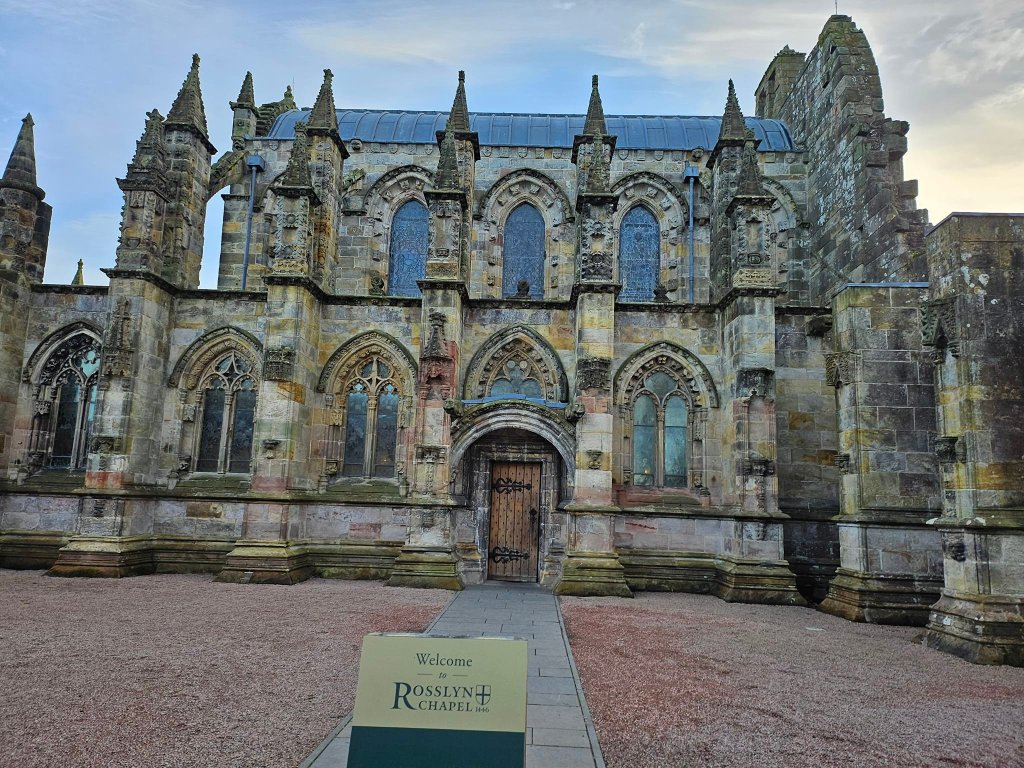
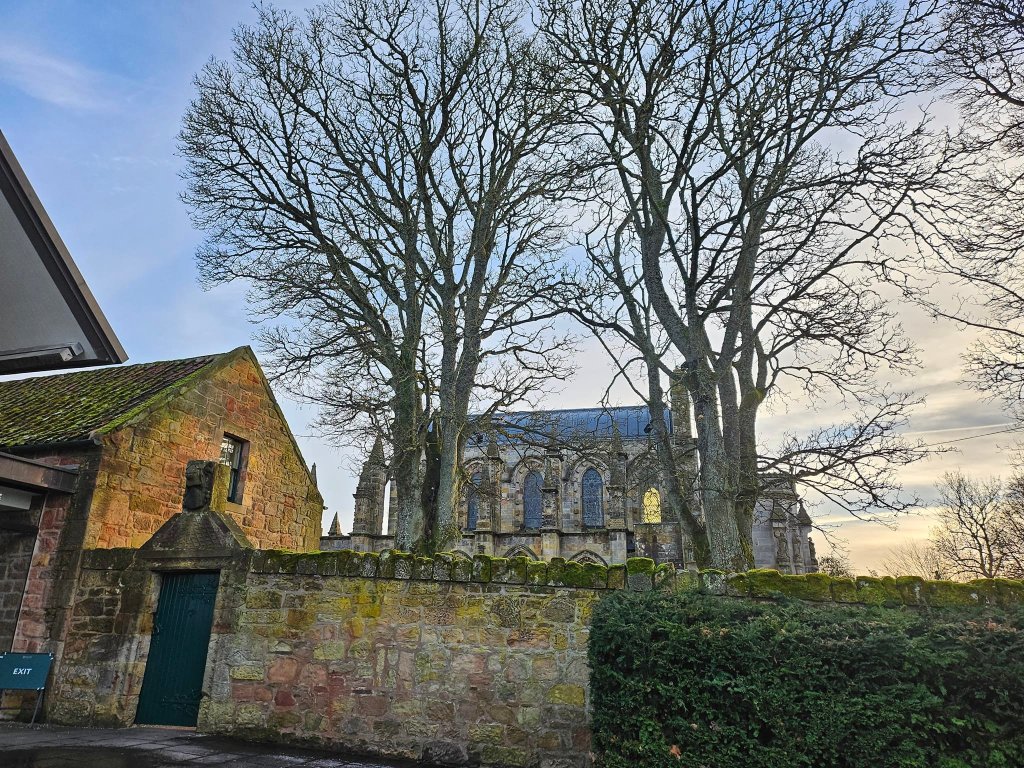
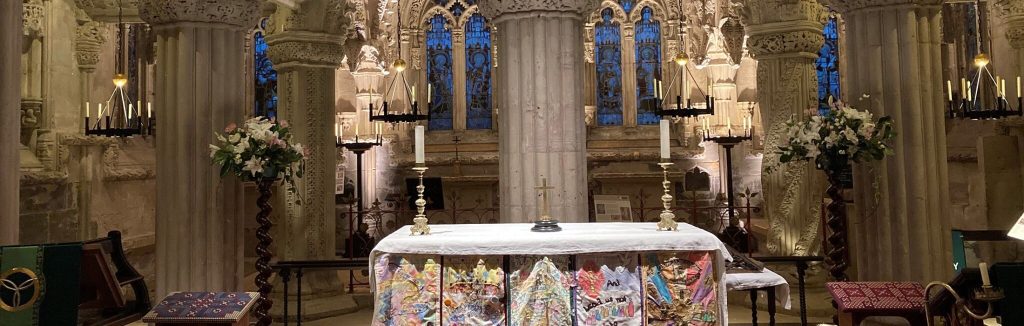
It added to the depth of the experience that no-one was allowed to take photos inside Rosslyn Chapel when my brother and I visited it on a cold November afternoon. It meant we could really concentrate on the breathtaking intricacy of the stonework and the overwhelming symbolism of the artwork. Outside was a different matter. There was a watery, ineffective sun trying desperately to shine when we went in, but as we finished our 90 minutes there, a full moon was rising and that added to the magical speculation.
Dan Brown may have brought this chapel into popular culture in his book The Da Vinci Code, but it was famous in its own right long before that, not only for the intricacy of the mediaeval artwork, but for the air of mystery that surrounds it.
Rosslyn Chapel, properly named the Collegiate Church of St. Matthew, was founded on a small hill near Rosslyn Castle, Roslin, in the mid-15th century (finished in 1446). The chapel was founded by William Sinclair. His family (my family!) descended from Norman knights who moved to Scotland when they fell out with William the Conqueror in the 11th century. My great great great grandmother who came to Australia in the middle of the 19th Century to help her widowed brother raise a brood of Sinclair children, came from Thurso Castle in Caithness and I traced her line back to the 5th Earl of Rosslyn and then to William Sinclair and further back to when the Sinclairs (St Clairs) were the Dukes of Orkney. Hence my eagerness to visit when we were passing by during our heritage trip.
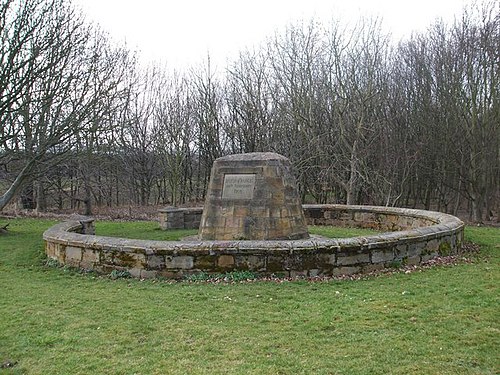
The Chapel was built in the same area as that in which the Battle of Roslin was fought in 1303. It was a resounding win for the Scots against the English and the Sinclairs were one of the three clans involved (along with the Frasers and the Cummingses), but The Battle of Roslin has fallen into relative obscurity when compared with Bannockburn, Stirling Bridge and the rise of Robert the Bruce (who I was also delighted to discover recently, was an ancestor of mine). One of the Sinclairs married the lady who the commander of the English Forces, one Lord John Segrave, was sweet on and he got permission from the king to conduct a punitive raid on the Scots who then ambushed and killed the English forces. I diverge again … there is a memorial to the battle at Roslin and it’s always worth knowing a bit of history behind such objects.
The purpose of the church was to celebrate the Holy Mass for all the faithfully departed, including the deceased members of the Sinclair family. It was thought that a fast ticket into heaven was to have people constantly praying for your soul. The Sinclairs did what many wealthy families did: they built the church in hopes of winning points with the guy upstairs. After the Scottish Reformation, Roman Catholic worship in the Chapel was brought to an end, although the Sinclair family continued to be Roman Catholics until the early 18th century.
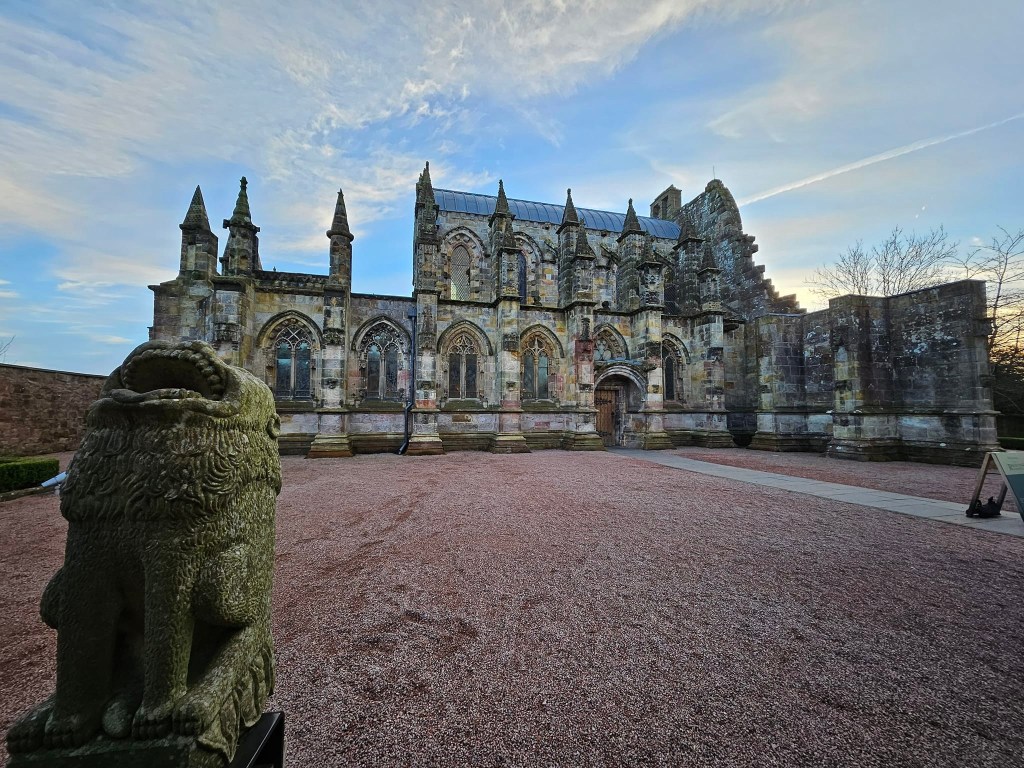
The chapel itself is actually quite small. Standing 12 meters tall and 21 meters long, it was originally built to be a full style Gothic cathedral in the shape of a cross. However, when William Sinclair died his son decided to stop construction. He closed up the “top” and in 1446, just made the existing building into a much smaller church. That’s the history lesson you get on the paid tour, then the guide points out just some of the architectural and symbolic features and leaves you to wander and try to commit it all to memory.
Scotland always puzzles and intrigues those of us born in the colonies.
Is there a monster in Loch Ness? Why did the ancient Scots love stone circles so much? How did they came up with the recipe for haggis (some speculate that stuffing the intestines of animals was a way for the Vikings to carry food on long voyages)? What is the real story behind The Fairy Flag of Clan Macleod? Against this tip-of-the-iceberg tapestry of thought-provoking riddles, nowhere holds as many as the mysterious Rosslyn Chapel.
It’s 45 minutes-ish outside of Edinburgh by the scenic route that we took, but apparently only seven miles. The intricately carved stone-work is laced with strange symbolism, ancient cults appear behind every story, and alien activity frequently gets reported by UFO hunters.
I unearthed some of the strangest stories surrounding Rosslyn Chapel for you. So, read on and see if you can, if not solve the mysteries, at least be intrigued enough to develop some theories of your own.
- Rosslyn Chapel Aliens. Lots of Aliens
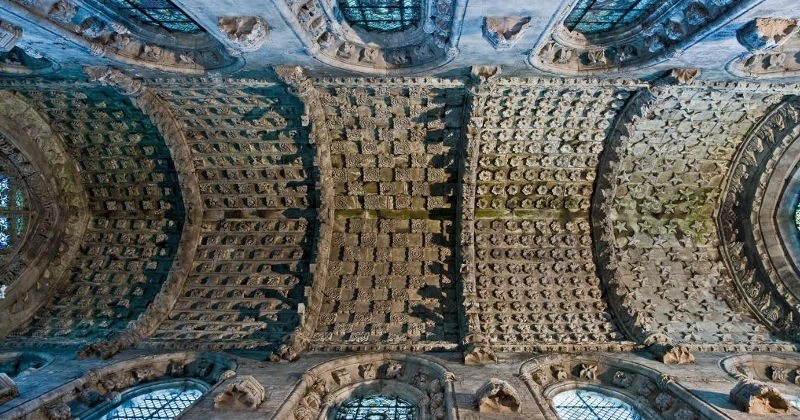
The Alien Conspiracy Theorists suggest Rosslyn Chapel is a stargate for extraterrestrials— a door or passage to another realm or universe—like the Pyramids of Giza, Stonehenge, and many more of history’s masterpieces. This is due to an idea that ETs can pass into our world because of the otherworldly geometric patterns. The beauty and wonder of these patterns lead people to think they couldn’t be the work of humans.
There’s even a little evidence for this theory. The area boasts more UFO sightings than average, and there are a few carvings that look a little like reptilian aliens.
2. A Musical Masterpiece Hidden in Plain Sight
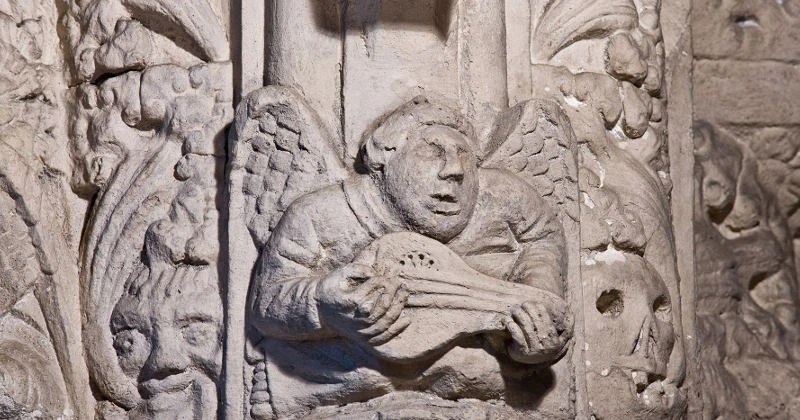
A 75-year-old musician and his son, an ex-code breaker, visited the chapel and immediately knew there was something more to the unique geometry. They spent 27 years trying to crack the code.
And eventually, they had a breakthrough. They saw angels playing instruments and 213 geometric cube carvings accompanying them sticking out of the arches. To their amazement, they found the geometric patterns on the cubes correlated to a Chladni Pitch. These are the patterns sand and liquid makes on a flat surface when certain musical tones are played.
By looking at these for the notes and an angel that points to a musical staff for the key, they managed to understand the architecture as a giant musical score. HOWEVER, I researched a bit and found that the Chladni Pitch was not invented till two centuries after the Rosslyn Chapel was built.
3. Rosslyn Chapel & The Murdered Apprentice
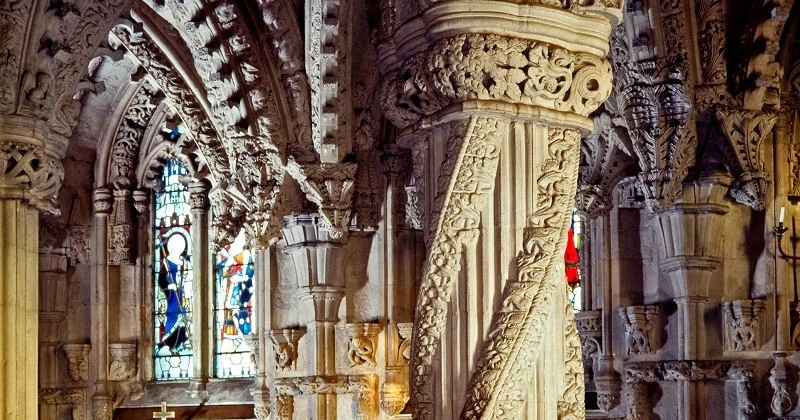
Perhaps the highlight of Rosslyn Chapel’s beautiful stonework is the Apprentice Pillar. The story behind this pillar isn’t so lovely.
While building the Rosslyn Chapel, the master mason went to Rome for inspiration. He entrusted his apprentice to follow his instructions until his return. Yet the apprentice was an ambitious young man, so he started changing the designs and created this pillar himself.
When the master mason saw that this pillar was far more beautiful than his own creations, he was enraged by jealousy. He struck down the apprentice and killed him.
No one knows if this is fact or fiction. But there’s some evidence supporting the story.
Firstly, there’s a carving of a young man with a mysterious cut on his forehead, possibly signifying the dead apprentice. And secondly, the history books record that the chapel’s construction was delayed because of a violent deed. Who knows what this talented apprentice could have created if he had continued his life?
Another mysterious fact to do with the pillar is that the vine twirling around it undeniably looks like the helix DNA structure that’s at the core of all life. Did the ancient architects know about molecular DNA?
4. Curious ‘Corn’ Carvings and ‘The Green Man’ Carvings Within Rosslyn Chapel
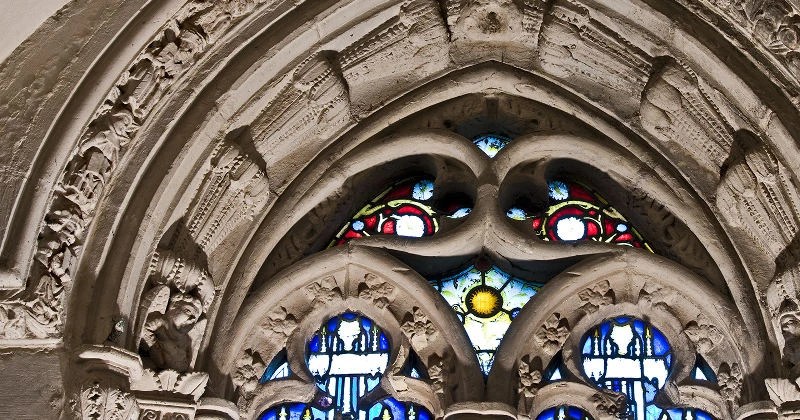
Carvings of corn cobs may sound like the most uninteresting thing within the mighty Rosslyn Chapel, but it’s completely, maddeningly mind-blowing. Because what else could it be?. And this chapel predates Christopher Columbus’ journey to America. How on earth did Scotland know about America’s indigenous plant life? There is a story that a Viking expedition, led by William Sinclair’s grandfather, Henry Sinclair, sailed west and landed on the coast of North America. The expedition, so legend claims, was forced by the coming of winter to hole up there for a number of months.
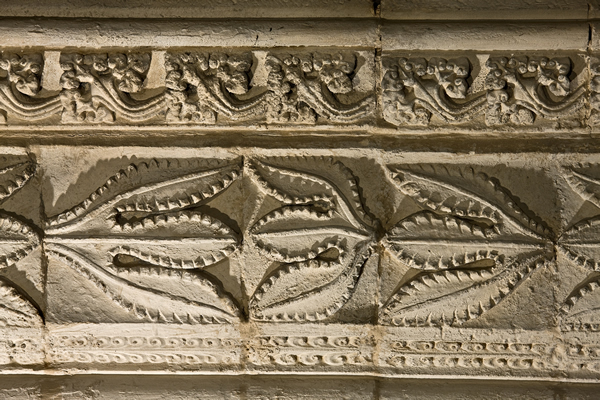
Then there are the green man carvings. There are a hundred of these dotted around the Rosslyn Chapel. But why? The green man, which can be found on many Roman-era buildings, symbolises the pagan gods that Christianity had banished. Historically, the green man symbolised the capacity for great goodness and the parallel scope for significant evil. The vines or foliage sprouting from the mouth are said to represent nature’s growth and fertility.
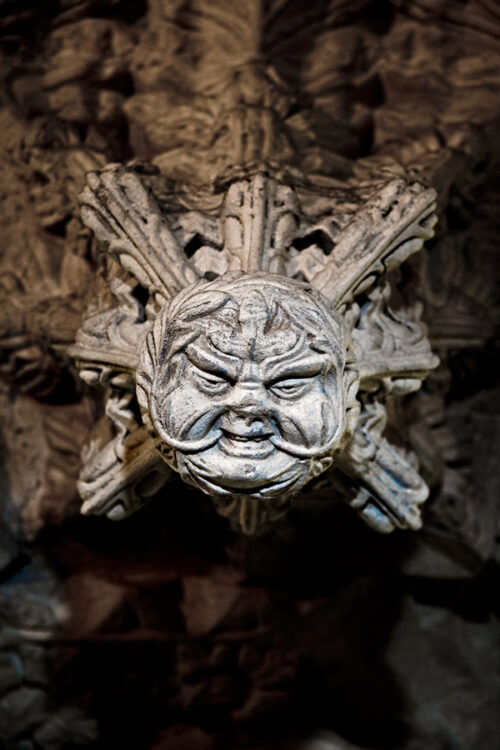
The Lady Chapel (not what you think it is, rude people!) proved a particularly good place to spot green men—ugly guys with foliage and vines growing from their heads— including one on the end bit protruding from the east wall like a boss, as they say. You can also see them in between carvings of angels, at the tops of the pillars. So why would this church and not any others at the time, allow them to be depicted everywhere?
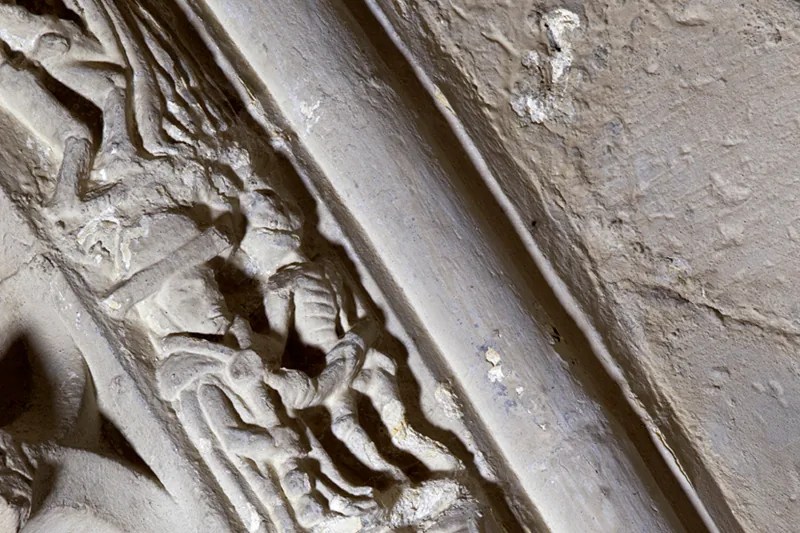
The Lady Chapel is the most highly decorated part of the building and also features the ‘dance of death’—people dancing with skeletons representing death in which there is a face which is claimed to be the death mask of Robert the Bruce. I loved the chance to study it for resemblances. I think I have his mouth.
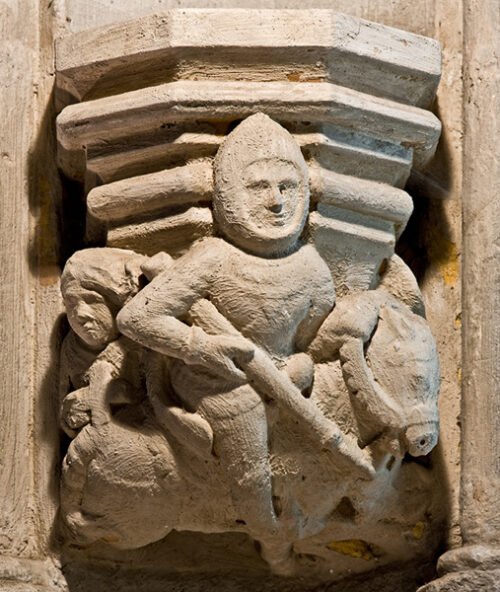
There is also a carving of William St Clair ‘The Seemly’ who was the founder of the chapel. I didn’t get much of ‘the seemlyness’, so it seems. The lady behind him is supposed to be an Austrian Princess he brought over to marry the king.
5. What’s Buried Beneath the Rosslyn Chapel?
Dan Brown’s The Da Vinci Code explored one of the strangest mysteries of Rosslyn Chapel: the conspiracy that connects it to the notorious Knights Templar. It depends how deep you go, but this theory can entangle the crucifixion cross, the blood of Jesus, the head of Jesus, the holy grail, and the knights themselves. It’s a grandiose story that’s as intriguing as it is fun.
In 1119, the Roman Catholic Church founded the order of the Knights Templar. They were exempt from all local laws and answered only to the pope. Their innovative banking systems throughout the crusades gave them power over 1,000 fortifications; and they were always the first into battle.
It’s even said at the Battle of Montgisard, an army of 500 Templar soldiers defeated an army of 26,000.
During the Crusades, they acquired the remains of the Solomon’s Temple that’s referenced in the Bible. It’s not known what they found there; it could have been the Holy Grail or even the remains of Jesus. But whatever it was, it made them extraordinarily powerful.
The Crusades came to an end in the 13th century because the Islamic armies became more united while communication issues pervaded the Christian factions. The end of this war gave the Templars less purpose, however after 200 years of integration they still had power and authority in towns throughout Europe.
The Templars became a ‘state within a state’, and this created a whole lot of tension in Europe. What’s more, King Phillip IV of France hated the Templars because he was in debt to them after using their services in his war against the English.
So, he seized upon the dark rumours that entrenched the Templars and ordered their arrest. It didn’t take him long to have them burnt at a stake for practising indecent kissing, financial corruption, and false idolisation.
But legend says many of the Templars escaped to Scotland with the treasure from Solomon’s Temple. It was a safe place to hide. They weren’t outlawed there, and they owned land. One of their properties was only nine miles from Rosslyn Chapel. There are many theories that support this idea. The St. Clair family had ties with the Templars, Robert the Bruce fought with them, the chapel has a hidden chamber, and there are Templar symbols within the chapel. William Sinclair
Though sadly, there are no solid facts to support these theories. But that doesn’t mean you can’t enjoy the intrigue and excitement that’s offered in The Da Vinci Code, The Holy Blood and the Holy Grail, and other fictional conspiracy books. You’ll find lots of books to choose from in the Visitors’ Centre. There’s also a coffee shop there and local craft items are sold.
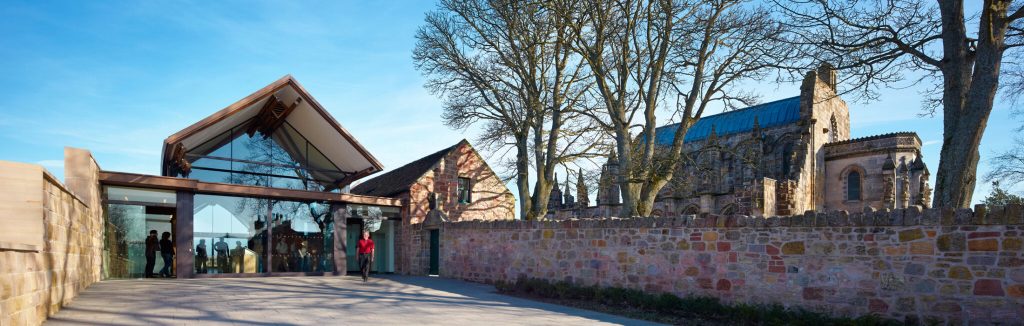
We were lucky to get in just turning up there. It was a quiet day. I recommend you book ahead to be sure of getting in as visitor numbers are limited and on a time limit of 90 minutes at a time. Monday to Saturday, the Chapel is open from 9am to 5pm. On Sundays it is open from 12pm to 5pm. Admission is eleven pounds fifty pence and seniors’ discount doesn’t start till you hit 65. You get a map (available in 13 languages) and a short guided talk.
Tickets are available online. We had a hire car, but tours are provided by local operators such as Rabbies: https://www.rabbies.com/
Photos inside the chapel are from the Official Rosslyn Chapel Website.
https://www.rosslynchapel.com/visit/
Visiting Rosslyn Chapel was a fitting end to our time in Scotland (and I kept my brother out of the souvenir shop).
 Margaret R Kelly
Leave a comment