What it’s like being an ageing emerging writer and writing in spite of AI (and why real writing has more value).
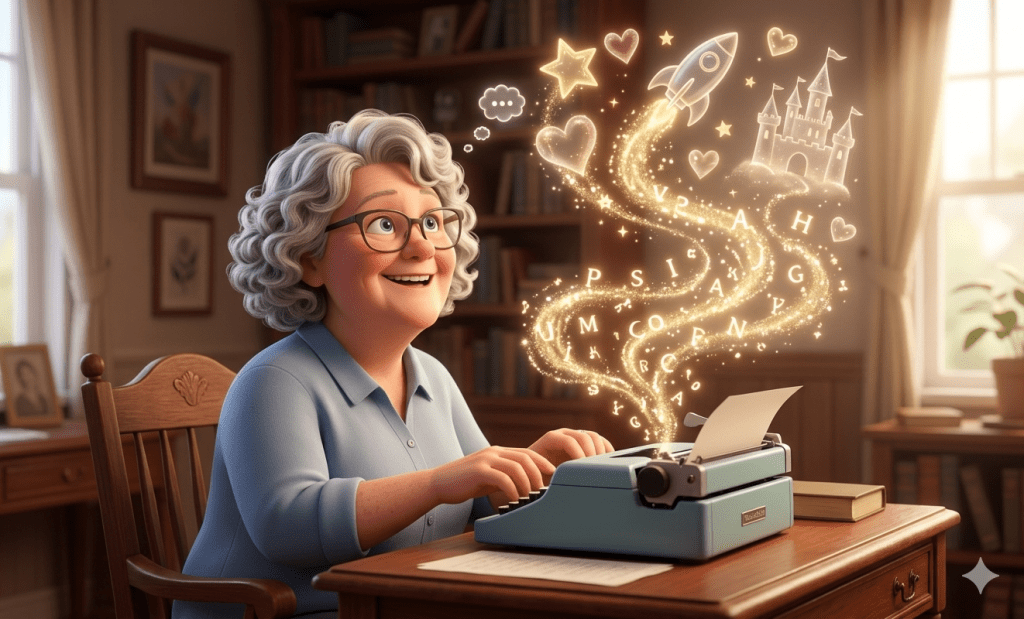
You can probably tell that I enjoy using AI to create pictures to accompany my blog posts, because visual art creation is not my thing. If it hasn’t yet crept into your workplace, you’ve probably also at least monkeyed around with it a bit to see what all the fuss is about. But using AI to write for me would be like painting a portrait with Hobbytex would be for Julie Frager (the winner of the 2025 Archibald Prize). I don’t tie myself into knots though over people using AI as so many writers seem to be doing.
The dance that creative writers do, that all artists do, is mysterious and primal. It is both work and play, both pleasure, and pain, to be drawn to the storytelling task, to observe the universe and attempt to capture a sliver for others to consider. I’ve waited my whole life to write, and will continue to do so whether anyone reads my writing or not. For those of us toiling at it and loving every minute of the process, we know we aren’t going to stop. There’s simply too much joy on the line.
It’s a helluva time to decide to become an author. I’m nearly 65 and took my official leap into this fray just a few years ago when I retired from teaching. The writing was on the wall back then (pun intended), but now Artificial intelligence is really here, trolling amongst us. There is no stopping it. It has some good to do, and I suspect plenty of damage.
AI-generated writing will settle into its appropriate place on the shelf, right along with an endless offering of other products available that meet the low standard of ‘good enough’. They’ll do in a pinch, just like other conveniences we’ve come to accept: cakes made from mixes instead of baked from scratch, sauce from a jar or packet instead of authentic butter chicken that takes all day to make, packaged, home-style bikkies that only look like they could have been pulled right out of the oven. These things are designed to be gobbled up quickly, but we know when we put them in our carts and in our mouths that they are only shortcuts created to imitate their betters.
You know AI isn’t writing this blog, right? I hope I don’t sound weirdly semi-formal, like the human embodiment of jeans and a blazer. That’s how AI comes across to me.
As well as writing, I also read a lot. A lot! AI’s getting better. It still skews toward the choppy and verbose; like my own writing before I did some courses to improve it . But AI texts are a lot better than they were. AI content is boring, isn’t it? The non-specificity of it, the frictionless vagueness, gives you nothing to hold onto. No emotional ‘feels’.
I’ve started reading like a detective. I don’t want to …
I want to sit on my park bench in the Queensland winter sun, with my little thermos of Dilmah, and fall so completely into the book I’m reading that I forget everything else. But lately, I’ve had a hum in the back of my head which is constantly debating whether the thing I’m reading was actually written by AI. Emails, books, captions, articles. Sometimes, I don’t really care. Sometimes, I really do. But no matter how trivial, I can’t shake the hum, because I want to understand how good AI is getting. I want to know if I’m a better writer than the machines; if I’m more creative than that confounding, exhausting, infuriating, marvellous, mercurial, tireless, connection-making god/gizmo, ChatGPT—a thing that operates on such a vast scale that it seems to know our species’ collective unconscious mind map. That thing that spits words out like popcorn.
Perhaps you’ve resolutely refused to look at it at all, because the very idea of it disgusts and appalls you, maybe even existentially disturbs you. If you fall into the latter camp, I understand your reaction perfectly. I’ve run the gamut of emotions when it comes to AI-generated output in regard to teaching as well as writing. And I’ve uncovered a few new emotions I didn’t even know I was capable of into the bargain. These new emotions have no name as yet, but an attempt to christen them might look like this: waaaarerfggb?, frlhullffernok?, splrk.
Getting an AI to emulate the intent of an author/playwright/screenwriter/poet/etc. is something else again. I’ve tried to enlist ChatGPT in this way. It was roughly akin to herding cats. Or an endless game of “sorcerer’s apprentice” from Fantasia. Set this thing to work and the digital broomsticks swing into action. The words proliferate, the alphabet soup rises swiftly around you, growing deeper and deeper or—better still, let us say piles of turds… Stock phrases, cliches, word redundancies, word repetitions and word repetitions and word repetitions and endless, metronomic clauses: the piles of word-turds mount up around your ankles, your shins, your knees…. Very soon you’re waist-deep and—yes, if you pick through them, maybe there is a good idea in there somewhere. Or half a good idea. Or something, at least, that will give you some sort of a steer. Throw enough shit at the wall? It’s not writing as we know it, Ruthie [my protagonist’s name], but perhaps it’s not entirely pointless. I’m a naughty writer perhaps, but I am occasionally guilty of asking ChatGPT to generate a scene for me. Just to get an opinion, just to get a page of turds with—maybe—that one good clue hidden within it. It’s not as if I’m using the actual output to populate the pages of my novels, eh?
In my limited circle of friends and family, there are a couple of tech-heads who love playing with AI. It is so unambiguously good at coding that it’s extremely difficult to resist it if you are comfortable working with code. The tech-savvy folk say, “Yes, wow, we do need to be afraid! AI is amazing!” And all my arts friends, all my book friends, are reading the literary output of ChatGPT and saying, “This? You think this is amazing?” AI is obviously better at coding than writing books.
When a sexy hot nerd tells me AI is great at writing, it makes me feel defensive and possessive. It makes me annoyed that they can’t, or don’t want to, see the nuance in a piece of fiction that makes it really great, truly amazing. Specially if I’ve written it. That’s precisely what many writers and content creators are scared of—a machine able to perform better than themselves.
So many of us are afraid of AI — afraid everyone else will read AI posts and poems and books, and won’t notice they were written by AI. Or worse: They will know, but they won’t care. They will think them boring.
I hate being bored by something I read, so I’ve developed a lot because of the competition from AI. The challenge and joy of writing has become: Don’t get bored or you’ll be boring to read. If I feel like I’m writing myself into a rut, I do something weird. Veer in a new structural direction. Invent a word, make a joke, write a scene to horrify or surprise myself. Through the experience of thinking so much about weirdness, I have noticed that the weird is all around. In fact, weird books seem to be having a bit of a moment. I could be in like Flynn in a flash.
What is great writing, exactly? Well, there’s a question—but you know it when you see it, when it shocks you and confronts you. Whatever else it might be, great writing must always be executed with intent. And that means using words carefully and exactingly.
I think we are all hungry to experience art that feels surprising—and human. It’s not just books. I like to catch a glimpse of the messy human behind the curtain; to hear podcasters mispronounce words, laugh, and correct themselves. I like when someone fires off a zany, too casual email in a formal context (“best regardz”). I even kind of like seeing typos in the wild lately. In a moment when we’re all being asked to question our realities all the time, I find it immensely soothing to know I am in the presence of humans.
More good news is that publishers and artists likewise are pushing back. Some consumers will, too. Others won’t. There will be readers who are satisfied, even thrilled, with AI-generated books whose authors say things like, ‘I’ve written thirteen rom-coms in the last six months’. People will be willing to pay for AI books, and they will use money that they could be spending to purchase work created by people like me who are toiling at it,— loving every minute we have to create art.
To be honest, I’m not sure just how AI works. I want to say it has something to do with sorcery. I don’t want to put words in its mouth (don’t worry, it does not have an actual mouth…yet), so here is how ChatGPT defined itself when I asked:
ChatGPT is an AI language model developed by OpenAI. It is designed to engage in natural language conversations, providing responses and information based on its training on a wide range of texts. It can answer questions, provide explanations, offer suggestions, and generate text in a conversational manner.
There doesn’t sound to be much joy in the process; no long meaningful eye-contacts or heaving bosoms, no soul.
Before I retired with a husband to support me, finding time to write felt like sneaking around cheating on work obligations or my business, to meet a lover.
Those who identify, proudly, as writers, know that this is how our craft demands our attention. It’s waiting for us to come back to bed so it can consume us again. It’s a master of coercive control and knows what we like and where we won’t go. It is jealous when we leave it to tend to other matters. To punish us while we’re away, it will suggest some small thing meant to distract us wildly until we crawl back to it, knowing that we are owned.
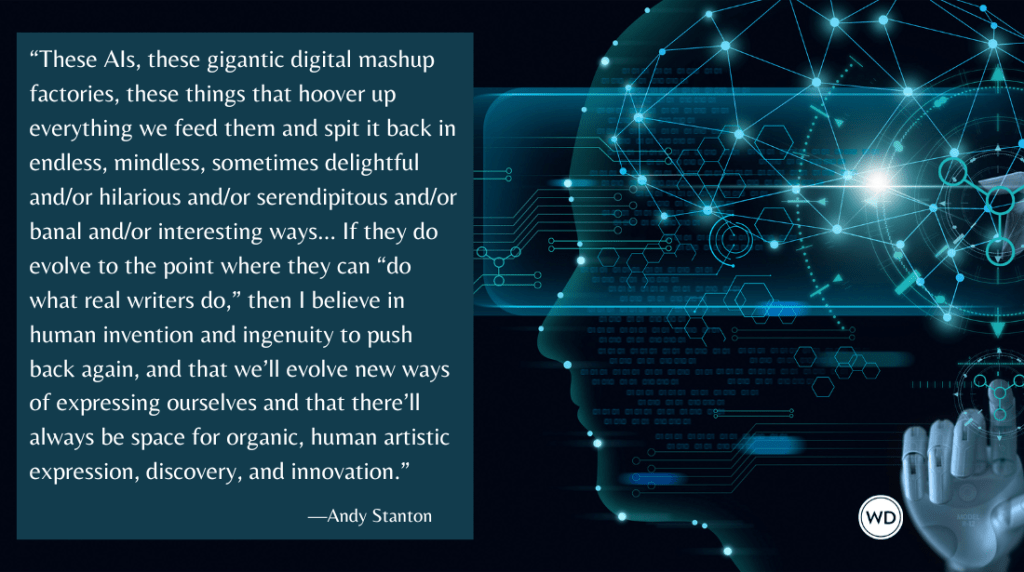
These AIs, these gigantic digital mashup factories, these things that hoover up everything we feed them and spit it back in endless, mindless, sometimes delightful and/or hilarious and/or serendipitous and/or banal and/or interesting ways… If they do evolve to the point where they can “do what real writers do,” then I believe in human invention and ingenuity to push back again, and that we’ll evolve new ways of expressing ourselves and that there’ll always be space for organic, human artistic expression, discovery, and innovation.
Writing’s not just the putting together of words: one, a thousand, a hundred thousand. It’s choosing the right words and putting them together in the right way, in order to make them bump and spark and communicate as closely as possible the author’s intent. When it comes to fiction, readers don’t want merely to be told something. Readers want to be shown something. Readers want to be made to feel and taste and live something.
We’ll still be sneaking away to our lovers, to our joy-spaces to make the real deal. And we’ll do so knowing we have the market cornered on a precious commodity that artificial intelligence will never be able to sweep up with bots and algorithms: hearts that beat, bones that break and souls that soar.


Leave a Reply