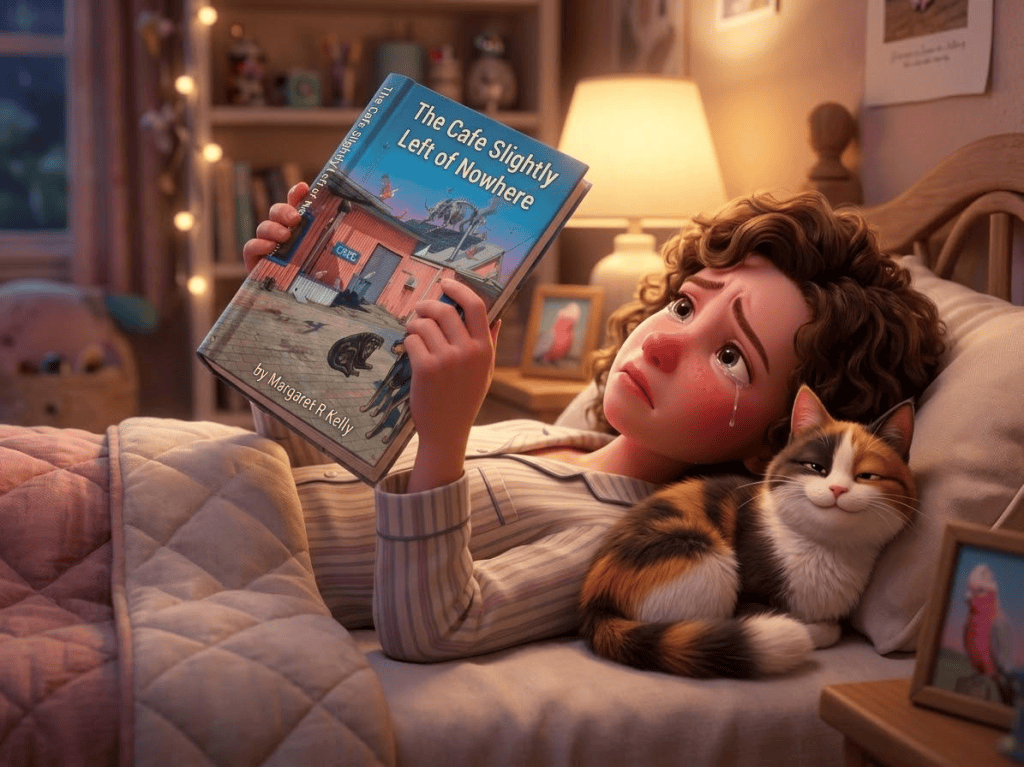
Good writers make readers think, great writers make readers feel—and the best writers make us feel with characters. It is a challenge to impact readers emotionally, and it takes skill to move readers beyond feeling sympathy, which is passive and centred in our own POV (sorry—Point of View), to feeling empathy, which involves actively understanding someone else’s feelings as if they were your own.
It’s a well-known strategy among writers to “torture” characters; seeing how a character responds to suffering will show us (as readers) what they are made of. Characters with big stories have big lessons for humans trying to understand ourselves and each other.
Where some writers go astray is in writing reactions to these challenging events, especially when characters cry on the page. If your goal is to make a reader feel something, having a character cry almost never works. When a character bursts into tears on the page readers may find themselves disconnecting from the character, and sometimes from the story completely. That’s why my protagonist, Ruth (Ruthie in my first novel) was conveniently brought up with the mantra, ‘Big girls don’t cry’. If readers cry, I take that as a good thing, by the way.
Being driven to tears may feel like the ultimate response in terms of expressing pain, but this is not always true. People cry for many reasons. Crying can be insincere, manipulative (Ruthie’s nasty husband resorts to it often)—and, on the page, both cliché and an easy way out. If a character is crying but the reader is also not moved to tears, there is immediate distance between the reader and the character, when what we want is for readers to feel connection with our character. Great books allow us to inhabit characters fully—this is why reading is such a wonderful escape. It’s important for writers to also read extensively to analyse their own responses to works in their genre.
Disconnection often occurs for me when a writer has a character crying in an opening scene. A man sobbing at his kitchen table may seem like an engaging opening; readers will wonder why he is upset, but curiosity doesn’t guarantee investment. It’s almost like passing a stranger crying in the street—we may feel a slight jolt of human compassion, but not much more.
Why? When someone else is crying, my natural response is to move to comfort that person, which disconnects me from my own emotional response. Think about a time in your life when someone you cared about was crying—you likely put your own emotions aside to comfort them. We want readers to be emotionally invested in our stories, so we need to avoid anything that moves them away from their own emotional response.
Tears can also make a character seem untrustworthy, or at the very least, weak. We have to be careful with tears even later in a story. Some readers might think—she’s crying about that? Humph. She should spend an hour in my world—and this is not the reaction we want. Readers want to learn from characters who are gritty, strong, or admirable in some way, a character who can do things we can’t. There is not much to like about Elizabeth Strout’s title character in Olive Kitteridge, but there is much to be examined. Through Olive’s layered character, I found myself thinking a lot about the pain and tenderness of being someone’s child. What struck me was how differently other characters in the novel experienced her: some feared her, others respected her, some loved her, and a few felt all of that at once.
That range of perspective is so real. Haven’t we all been someone’s comfort and someone else’s discomfort, sometimes in the very same moment? Not once though, does Olive cry, and that’s important.
There is an exception to this ‘no crying’ rule; if you are developing a character who is weak, manipulative, or unreliable, then bring on the tears! Just be clear that you are doing this to evoke a particular response. Tears are problematic when the author’s intention is for them to be taken seriously, but they are not interpreted that way. Keeping a skeptical reader in mind is a helpful way to dial back overwrought emotional responses.
Creative Writing around crying also disconnects readers. Writing a scene which makes a reader cry takes a whole lot of work. Writing a scene which makes a character cry takes just a few words—“Alexis sobbed”; “Joe’s eyes filled with tears.” Those few words will not earn reader goodwill or authentic emotional responses. Sometimes writers try to make character’s tears feel more meaningful by using “creative” language; however, creative language often sounds ridiculous: “Her almond-shaped grey eyes felt like they were sweating”; “She blinked away hot wetness”; “He felt a salty something prickle at his eyelids.” This overwriting feels like “cheating.”
If you absolutely have to have a character cry, it’s probably best to just say that they are crying. If you want to show off a bit of purple prose, focus on a small moment, imagery or symbolism. There is the potential danger of relying on clichés here, but something like watching water gather on a broad leaf, clouds shimmer across a sunset, or ice strangle a tree branch can evoke emotion much more effectively than the words “she cried.”
When tempted to write that a character cried, look for the emotions behind it and then the emotions beneath the emotions. Anger, for instance, often masks shame, fear, or guilt. Sorrow can arise from abandonment, loss, or disconnection. Push yourself to understand why your character is crying—and convey that very specific emotion to your reader. Readers are (probably) attempting to become more emotionally intelligent, so gifting readers emotional lessons is important. Probe past sorrow. Go as deep into your character’s psyche as possible.
I like to ask myself repeatedly why a character is crying. The answer is usually banal initially—her feelings are hurt, for example—but as I probe I get to a more profound understanding. Yes, her feelings are hurt, but more importantly, she’s realising that she is not as innocent as she would like to think she is. This is much more interesting—and hopefully more helpful to readers—than just knowing that she feels sad or hurt.
Always when you read a book, be aware of how the emotions affect you. The moment in a book that evokes emotion in you as a reader is probably not reading the words “Ruth burst into tears.” Identify where you are moved and try to model your own evocation of emotion off that type of moment.
The best book scenes don’t impress you—they recognise you. They articulate the half-formed thoughts you’ve carried quietly, the emotions you didn’t know how to phrase, the truths you assumed were yours alone. These lines feel intimate not because they are dramatic, but because they are precise. They arrive at the exact intersection of memory, longing, self-doubt, hope, and acceptance. Often, it’s not that the thought is extraordinary—it’s that you are finally ready for it. This is the magic of reading: discovering that your private inner world has been visited before, carefully observed, and put into words by a stranger who lived in another time, place, or body.
Let your characters be weird. Mine all are. The things people do to cope with suffering are fascinating. Unique ways people attempt to regulate their emotions are interesting—and this will give readers more insight into the specific experiences of your character. Maybe they transmute their sorrow into creativity or perfectionism.
Having a character do something unconventional, like laugh when they should be crying can also be a way to invite readers to explore things like a character’s upbringing, cultural messages about sorrow and grief, and the impact of trauma on people’s responses. “Inappropriate” responses to sad events are much more interesting and can teach us so much more than watching a character cry ever could. For instance, after Ruthie’s father dies, a boy she knows says, ‘Sorry for your loss.’ She answers, ‘It’s my pleasure.’
It’s way more interesting to read if your characters are disconnected or stoic. There are many stories in which terrible events happen but the protagonists manage without tears; this invites us to wonder about what they are feeling inside and why they may be disconnected from these feelings. This process of wondering is an invitation for readers to try to connect with deeper emotions. It’s hard not to feel a little curious about a character who should be crying but isn’t.
I’m a bit obsessed with the writing of James Baldwin at the moment. Through reading it, I’ve discovered that ‘earning’ a character’s tears may be best at the story’s end. In James Baldwin’s Sonny’s Blues, the narrator describes himself as feeling on the verge of tears several times, but even at the end of the story, when the character ‘felt my own tears begin to rise,’ he contains them. We are moved emotionally throughout many segments of that story, however, so the description of the protagonist’s suppressed tears at the end does feel ‘earned.’
At the opening of the story Baldwin doesn’t have this character crying—instead he sets us up with this vivid description of navigating emotion: ‘A great block of ice got settled in my belly and kept melting there slowly all day long, while I taught my classes algebra. It was a special kind of ice. It kept melting, sending trickles of ice water all up and down my veins, but it never got less. Sometimes it hardened and seemed to expand until I felt my guts were going to come spilling out or that I was going to choke or scream.’
This initial language, in which the narrator grapples with his emotional response in a way which lets readers ‘in,’ makes us trust him and want to stay with him on his tortured journey. The impact on readers is vastly different from something like ‘I burst into tears upon receiving the news about my brother’; Baldwin’s eloquent language is what conveys the depth of his emotion. I wish I could write half as well.
As with any “rule” in writing this advice is made to be broken—but thinking intentionally about reader’s needs will always help us craft better stories. Crafting better web-posts with pictures and headings? Not my scene today. If you need to read this, you will.
— Margaret R Kelly


Leave a Reply