I see myself as a writer. I’ve been kept awake at night thinking about and working on a story and found myself with finished pieces that I can’t recall taking shape; I’ve also struggled and felt like giving up. While the moments of magic happen, writing, for me, is hard work and at times incredibly frustrating.
Amongst the literati in the writers’ groups which I sort of follow and attend, I’ve noticed a growing number of aspiring writers disinclined to read. How can anyone claim to be interested in writing without being serious about reading? I just don’t get it. Reading is not only an utter pleasure but it is also like the yang to the yin of being a writer. And it is in the pleasure of reading where I first took up the challenge of writing, in trying to emulate the wordsmiths whose stories possessed me so completely that the rest of the world would fade away so long as I kept turning the pages and allowed their words to fuel my imagination.
The ‘not wanting to read’ wave is the same mentality that drives the Japanese “mobile phone novel” phenomenon, keitai shoushetsu. All the rage in Japan and China, stories and books written via cellphones are huge business. according to Wired UK: “The largest mobile phone novel site, Maho i-Land, features more than a million titles and is visited 3.5 billion times each month.” (Wired UK).
It’s happening here too. I know one ‘writer’ who dictates her novels as she’s driving to and from work in peak-hour traffic. She considers herself a successful author. She publishes (online) an average of two books a month.
Imagining the quality of these works lends itself to reconfiguring Justin Bieber fan fiction laced with text-message acronyms. Notions of “craft” are not a real issue for these authors. But let there be no doubt, if these are the sorts of books publishers can sell, then these are the books the publishers will champion. It’s obligatory to have a finger in every social media pie if you want to be published—a ‘digital presence’, and an author website (you’re looking at it!). And I hate that. I also have not succeeded in being published despite toeing the line of least resistance.
I feel representative of a dying breed, so took a moment to document my reading history for posterity. I’d be interested to hear some of those by other people.
My earliest reading memory
The Wait for Me Kitten by Patricia Scarry (wife of the more famous Richard Scarry). My Auntie Judy and my mum used to read the Little Golden Book to me at night and then one day I could read it myself. I read it over and over in bed, this story of a struggling little kitten always blamed for the messes that his siblings made. The thrill of that never got old. I must have been four. And then I got onto The House at Pooh Corner. My very favourite toy was a Fuzzy Felt on the flat 2D surface of which I re-enacted all the adventures.
My favourite book growing up
I was really into books about horses. Obsessed. My favourite, the one that made me think about being a writer for the first time, was the classic Black Beauty by Anna Sewell. It’s told in the first person (which was a revelation to me) in the voice of a black horse in the days when horses were the main form of transport. It was the opposite of going through the Looking-Glass (incidentally another favourite). It pushed me into such useless pastimes as researching the times in which Black Beauty lived and the Crimean War and types of carriages.
The books that changed me as a teenager
I read Harper Lee’s To Kill a Mockingbird when I was 14 or 15 for a high school class. Like Scout, the main character, I lived in a small town and was an observer. Like her, I saw a lot of bizarre behaviour and racism. I loved how as a reader, I got right into her head. I think it was a book in my youth that really solidified my desire to be a writer, that made me feel it was a creative thing to want to do, just as some kids were good at sewing or painting. And the writing in that book made me ache to do it even more. I also loved Thomas Hardy and DH Lawrence for their purple prose and the pall of sadness that seems to hang over their books.
The writers who changed my mind
I have written a lot of pithy, voicey, minimalist short stories which never won anything. After all, anyone can write. Right? Two writers happened: I met my dear friend, Stephen King, over and over again and I read Virginia Woolf for the first time. The writing of each of these authors changed mine. I’d been skating on the surface before. I began to mindfully study their techniques. And many others subsequently. I’m now a very different writer.
The book that made me want to be a writer
Apart from Black Beauty, I have to go back to The Silver Brumby series by Elyne Mitchell. Basically the characters are horses with freedom and it’s an Australian setting. I very distinctly remember being on my twin bed reading that book and deciding to be a writer. I thought I would write for kids, books about horses, exactly like hers. I wrote lots of now embarrassing ‘fan fiction’ stories. It still surprises me that that’s not how it turned out, that I have not written one book for kids. Yet. I went to Corryong just to visit Elyne Mitchell’s grave in about 2020
The author I came back to
I was assigned Wuthering Heights over the summer I was 15 and I hated it. I could not get past the first 20 pages. I picked it up again when I was heartbroken and perhaps wanted to feel even worse, but it was a revelation. I have read it many, many times now.
The book I reread
The Grapes of Wrath by John Steinbeck is another one that I didn’t appreciate in high school, even though our school editions had horses on the cover, but have gone back to several times over the course of my life and find so much more there each time. Understanding context is so important. The voices, the beauty and exploration of language, the depth of the family struggles, the grappling with race, mental illness, the legacy of the south. Most of American history, past and future, can be found in that book published in 1929.
The book I could never read again
Oh, don’t make me say it. The Thorn Birds by Colleen McCullough. How I swooned over that book as a teenager. But I think it’s best to let that saga of a priest falling in love with a little girl who shares my name remain vague in my memory. I have read and loved most of McCullough’s books just once.
The book I discovered later in life
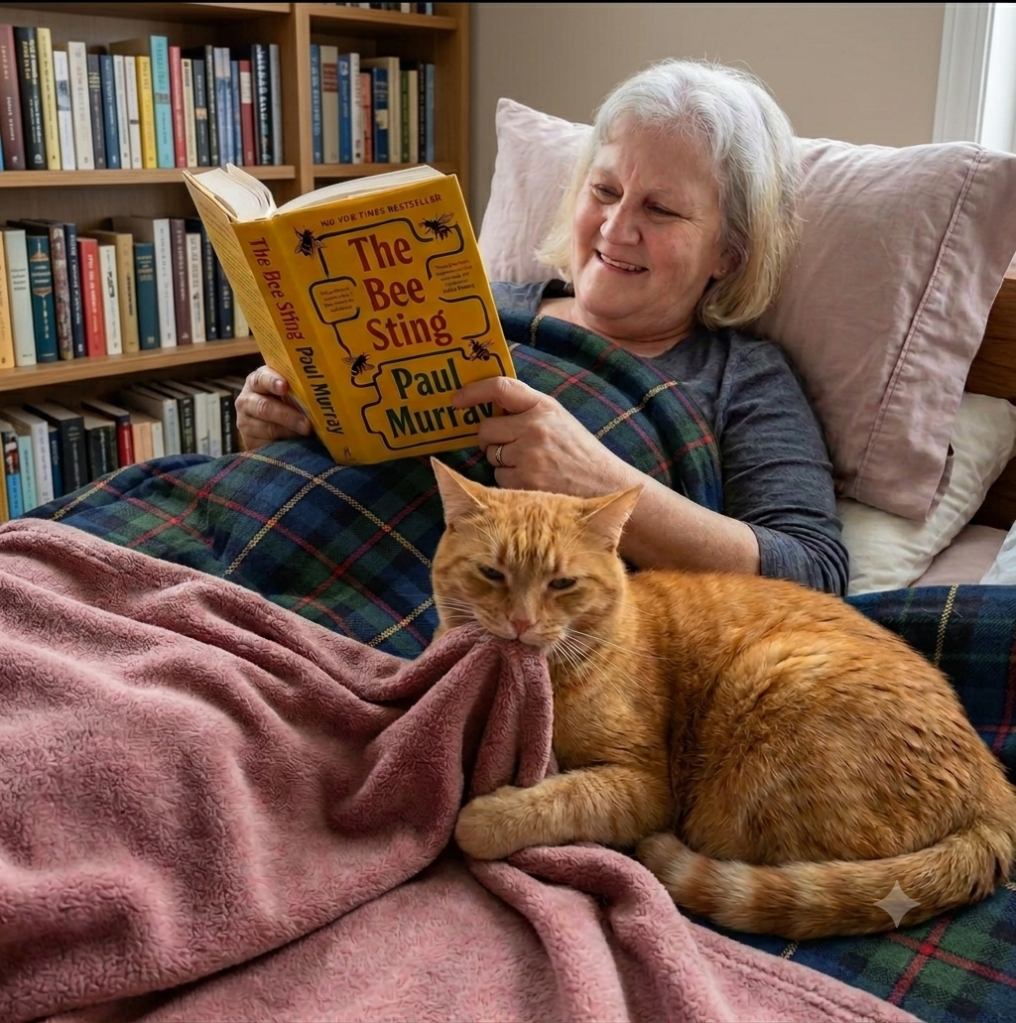
Paul Murray’s The Bee Sting had been recommended to me several times, and finally when I was doing the AWC’s Write Your Novel course, one of my fellow students said I wrote with a similar tragicomedic style to Paul Murray. So when I saw it in an airport bookshop in Dublin, I bought and read it. Now I have become another proselytiser. Six hundred and forty five exquisite pages. Never have I read a book that caters so perfectly to my sense of humour.
The books I am currently reading
I normally have a few things going at a time. I’ve been slowly moving through Anthony Powell’s A Dance to the Music of Time, which is getting very good now the war has started. I’m also reading Stone Yard Devotional by Charlotte Wood, Monsters in the Archives (about Stephen King’s drafting process) and for ‘research’ for a new book, Diana Gabaldon’s Outlander series, Stuff The English Stole by Marc Fennell and Writers and Lovers by Lily King, which is blowing my mind.
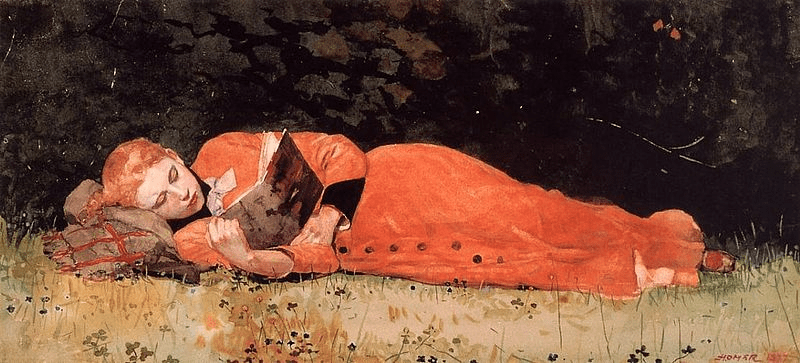
The New Novel, by Winslow Homer via Wikipedia
It puts my back up when people brag about not reading. Am I alone in this? Obviously. I like being alone.
Humanity, as a whole, however, is losing its ability to be alone with nothing but our thoughts.
Both writing and reading are solitary acts. They are both also liberating acts that can free practitioners from reality for as long as someone chooses to read or write. You fall into the moment of the act, commit yourself to it, indulge imagination to the point that it usurps the daily grind — the tedium of work, relationship troubles, baleful news reports — and you the reader, you the writer, are all that exist as a sounding board for the words, no matter what their story.
The pervasiveness of social networking corrodes the ability of words to bestow the enchantment of solitude. Being alone is not so much considered a freedom or luxury anymore, especially among teenagers. It’s a punishment. Behind closed doors, away from nosey parents and annoying siblings, the connection to friends and the details and distractions of life stream through walls and windows, eradicating distance.
This diminishing of distance has irrevocably changed our sense of how we describe the world we inhabit. Immediacy kills metaphor and its demise unquestionably plays a role in perspectives on literary craft. Or maybe craft is of little interest to certain want-to-be writers. In our 15-megabytes of fame culture that favors quantities — friends, followers, number of comments — over quality this might be what it all comes down to, because if you can be recognised and rewarded as a writer without being much of a reader, guess what —- most people will not try to read literary novels.
In fact, the channeling of experience through social media as it happens, and seemingly before a moment is even allowed to pass fully, undercuts one of the traditional tenets of reading and writing: metaphor. In our age of immediacy, the associative distances between people that shape shift with the diversity of Yatala-pie varieties are endangered.
Ambitious, talented writers will continue to exist and their writing will be great because they have read. And yes, there will remain people who have nary an interest in writing but luxuriate in an afternoon of reading. There’s a devaluing of imagination as it departs on flights of fancy brought on by just being with yourself. This is what is changing us in profound, yet to be fully realised ways.
Wanting to write without wanting to read is like wanting to use your imagination without wanting to know how.
I welcome opinions and discussion on my Facebook page under where this link is posted. Please no dick pics.


Leave a Reply